
















Bakuchiol Serum for Wrinkles: How It Works, What the Evidence Shows, and How to Build an Effective Routine

Fine lines rarely appear overnight.
At first, you may notice that makeup settles differently around the eyes. Then a line on the forehead remains visible even when your face is relaxed. The skin may look less smooth in bright light, feel slightly less firm than it used to, or appear creased more easily after sleeping.
The natural reaction is to look for the strongest anti-aging ingredient available.
For many people, that means retinol.
Retinoids have a substantial place in evidence-based skincare, but they can also introduce dryness, peeling, burning, or irritation—particularly when the concentration, frequency, or surrounding routine is too aggressive.
That creates an important question for people who want to improve the appearance of fine lines without immediately building their routine around a retinoid:
Can a Bakuchiol Serum for Wrinkles actually help?
Bakuchiol has attracted attention because it is chemically different from retinol while producing some retinol-like biological effects. Human research has examined topical bakuchiol for facial photoaging, wrinkles, pigmentation, elasticity, and firmness, including a randomized double-blind clinical comparison between bakuchiol and retinol.
The evidence is promising, but the ingredient deserves a more precise explanation than simply calling it “natural retinol.”
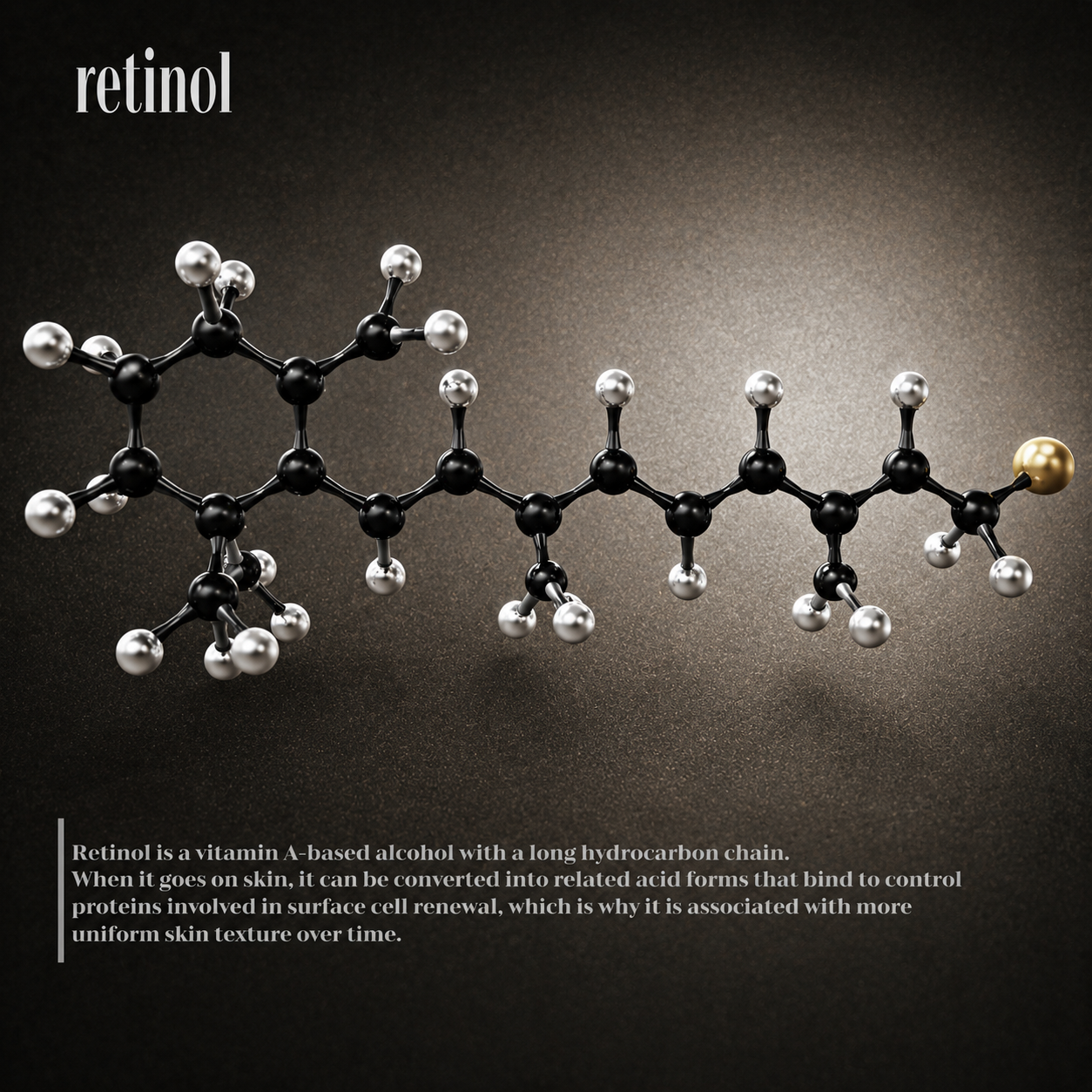
Bakuchiol is not retinol.
It is not a vitamin A derivative.
And using bakuchiol does not mean you are secretly using a weak form of retinol.
Instead, bakuchiol is a distinct skincare ingredient that appears to influence some of the same pathways relevant to visible skin aging while generally being associated with a different tolerability profile.
That makes it particularly interesting for people whose goal is not simply “anti-aging,” but a more specific combination of concerns:
- Fine lines
- Early wrinkles
- Uneven-looking texture
- Reduced firmness
- Photoaging
- Dryness accompanying visible aging
- Sensitivity to stronger anti-aging routines
- A desire for a more gradual nighttime renewal strategy
The smartest way to use bakuchiol is therefore not to treat it as a fashionable retinol substitute.
It is to understand what causes wrinkles, what topical skincare can realistically influence, what the clinical evidence actually shows, and how bakuchiol fits into a complete routine.
Does Bakuchiol Serum for Wrinkles Actually Work?
Bakuchiol serum may help improve the appearance of fine lines and wrinkles when used consistently. Clinical research has found improvements in photoaging, wrinkles, pigmentation, elasticity, and firmness with topical bakuchiol, including a randomized trial in which bakuchiol and retinol produced comparable improvements in wrinkles and hyperpigmentation over 12 weeks, while retinol caused more scaling and stinging.
That does not mean bakuchiol and retinol are identical.
It means human clinical evidence supports bakuchiol as a legitimate ingredient for improving visible signs of photoaging.
One of the most frequently cited studies was a prospective, randomized, double-blind trial published in the British Journal of Dermatology. Participants used either 0.5% bakuchiol twice daily or 0.5% retinol once daily for 12 weeks.
Both groups showed significant improvement in wrinkle surface area and hyperpigmentation.
Researchers found no statistically significant difference between bakuchiol and retinol in those measured outcomes, while participants using retinol reported more facial scaling and stinging.
The study can be reviewed through PubMed.
This is meaningful evidence because bakuchiol was directly compared with an established anti-aging ingredient rather than being evaluated only through consumer satisfaction surveys.
But it is equally important not to overstate what one trial proves.
A later systematic review of human bakuchiol studies found encouraging results across aging, acne, and post-inflammatory pigmentation, while also noting that much of the existing clinical literature uses combination formulations, open-label designs, small participant groups, or other methodological limitations.
In other words:
Bakuchiol has real clinical evidence behind it, but the evidence base is still smaller than the evidence base for retinoids.
That distinction makes this a much more useful conversation.
You do not have to choose between claiming bakuchiol is a miracle or dismissing it because it is not retinol.
It can occupy its own legitimate place in skincare.
What Wrinkles Actually Are

Before choosing a serum, it helps to understand what you are trying to change.
A wrinkle is not simply “dry skin.”
Wrinkles develop through a combination of structural, environmental, mechanical, and biological changes.
Some are primarily dynamic.
Some become more permanent over time.
Some are exaggerated by dehydration.
And some reflect deeper changes in dermal support that a moisturizer alone cannot completely reverse.
Dynamic Lines
Dynamic lines appear when facial muscles move.
Examples include:
- Forehead lines when raising the eyebrows
- Crow’s-feet when smiling
- Lines between the brows when frowning
Young skin often returns quickly to a relatively smooth resting position after facial movement.
As the skin’s structural support changes with age and cumulative environmental exposure, those lines may remain increasingly visible even after the expression stops.
At that point, a dynamic line begins to behave more like a static wrinkle.
Static Wrinkles
Static wrinkles remain visible when the face is relaxed.
These may develop from repeated movement, changes in collagen and elastin, long-term ultraviolet exposure, changes in skin thickness, and other age-related structural processes.
A topical serum can improve aspects of skin texture and photoaging.
But no topical cosmetic product should be marketed as though it can erase every established deep wrinkle.
That is not realistic skincare.
Someone with deeply etched lines may still benefit from a good routine, but professional procedures and prescription treatments occupy a different category of intervention.
Dehydration Lines
Some lines look much worse when the outer layers of the skin are dehydrated.
These are often fine, superficial creases that become more obvious when skin lacks water.
Hydrating the stratum corneum can make the surface appear smoother and more supple, sometimes reducing how visible those fine lines look almost immediately.
This is not the same thing as rebuilding dermal collagen.
The visual result can still be useful.
Understanding the difference prevents misleading claims.
If a serum makes fine lines look softer after one application, part of that effect may come from hydration and emollience.
Longer-term changes in photoaging require consistency.
Why Skin Develops Wrinkles
Wrinkle formation does not have one cause.
It is the cumulative result of multiple processes operating at different depths of the skin.
Collagen Changes
Collagen is one of the major structural proteins of the dermis.
It contributes to strength and structural support.
As skin ages, collagen production and organization change. Existing collagen can become increasingly fragmented, while the skin’s ability to maintain the same youthful dermal architecture decreases.
This contributes to:
- Fine lines
- Wrinkles
- Reduced firmness
- Changes in skin thickness
- Less structural resilience
This is why many evidence-based anti-aging ingredients are studied partly for their effects on collagen-related pathways.
Early laboratory research into bakuchiol found that although bakuchiol and retinol are structurally different molecules, they produced similarities in gene-expression patterns associated with skin aging.
A clinical study subsequently reported improvements in lines, wrinkles, pigmentation, elasticity, firmness, and photodamage after 12 weeks of a bakuchiol-containing product.
Readers who want a broader explanation of the ingredient itself can begin with Elora Clinic’s complete guide to what bakuchiol is.
Elastin and Elasticity
Collagen is not the entire story.
Elastic fibers contribute to the skin’s ability to deform and return toward its original shape.
With chronological aging and long-term ultraviolet exposure, the organization and function of the dermal extracellular matrix can change.
Skin may therefore feel:
- Less springy
- Less firm
- More easily creased
- Slower to recover after movement
This is one reason wrinkle care should not focus exclusively on “filling lines.”
You are supporting a complex biological structure.
The Skin Barrier

Wrinkles originate partly from deeper structural changes, but the surface of the skin still determines how dramatically those wrinkles appear.
The outermost layer—the stratum corneum—helps regulate water loss and contributes strongly to surface smoothness.
When skin becomes dehydrated, rough, or irritated, fine lines often become more visually obvious.
Imagine a dry piece of paper compared with a smoother, more flexible surface.
The analogy is imperfect, but the visual principle is useful.
Well-hydrated skin reflects light differently and usually appears smoother.
This does not mean hydration removes structural wrinkles.
It means an anti-wrinkle routine that ignores barrier health is incomplete.
This becomes particularly relevant when someone has already tried retinol but abandoned it because persistent peeling made the skin look temporarily more lined and irritated.
Photoaging: Why Sun Exposure Matters More Than Most Serums
If wrinkle prevention is the goal, sunscreen deserves more attention than almost any treatment serum.
Ultraviolet radiation contributes substantially to premature visible skin aging.
Repeated UV exposure affects collagen, pigmentation, skin texture, and other structural components.
The resulting pattern is commonly described as photoaging.
Typical signs include:
- Fine lines
- Deeper wrinkles
- Uneven pigmentation
- Rough texture
- Loss of elasticity
- Uneven tone
This matters because applying an expensive nighttime serum while repeatedly exposing the skin to ultraviolet radiation without adequate protection works against the same long-term goal.
No Bakuchiol Serum for Wrinkles should be treated as a substitute for sunscreen.
Think of the routine in two categories:
Daytime: reduce preventable damage.
Nighttime: support hydration, recovery, and targeted skin-renewal goals.
That division creates a much stronger anti-aging routine than relying on one hero ingredient.
How Bakuchiol Works in Aging Skin
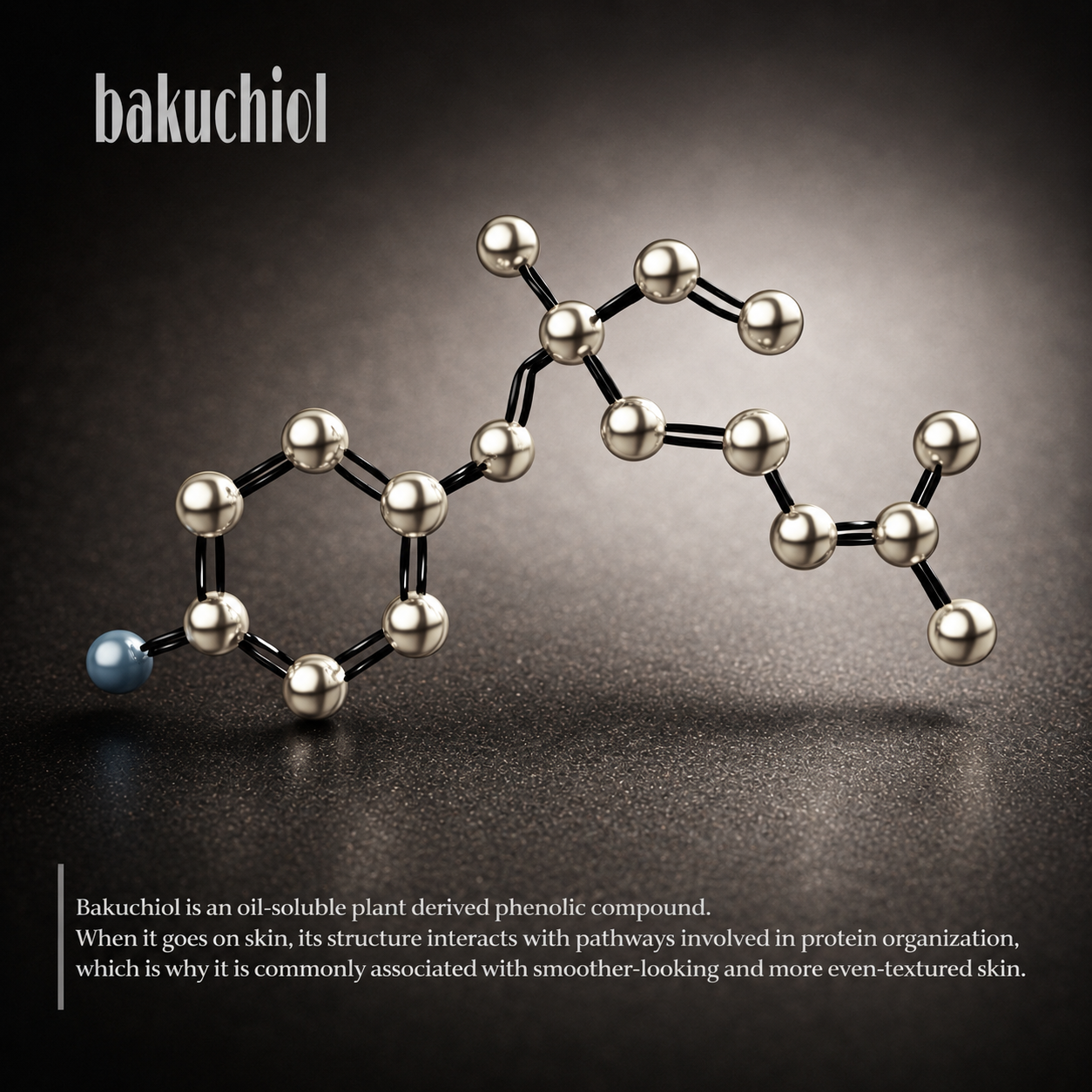
Bakuchiol is a meroterpene phenol associated with the plant Psoralea corylifolia, also known botanically as Cullen corylifolium in current classifications.
It is frequently described as a “retinol alternative,” but that phrase can become misleading if taken too literally.
Bakuchiol and retinol do not have the same molecular structure.
Bakuchiol is not converted into retinoic acid.
And it should not be categorized pharmacologically as a retinoid.
What makes the comparison interesting is that research has found overlapping downstream effects related to gene expression and visible photoaging.
Retinol-Like Signaling Without Being Retinol
A foundational 2014 study evaluated bakuchiol using gene-expression profiling and reported similarities between bakuchiol and retinol in pathways associated with extracellular matrix and skin aging.
This led researchers to describe bakuchiol as having “retinol-like” functionality despite the lack of structural similarity.
That finding was followed by clinical research.
The important wording here is retinol-like.
Not identical.
Not equivalent in every biological pathway.
Not a vitamin A derivative.
If you want a deeper comparison, Elora Clinic’s bakuchiol versus retinol guide examines where these ingredients overlap and where they should remain separate concepts.
Why Bakuchiol May Improve the Appearance of Wrinkles
Wrinkles are influenced by several factors that topical bakuchiol may potentially support:
Skin texture: smoother surface texture can make fine lines appear less pronounced.
Photoaging pathways: clinical bakuchiol research has specifically evaluated facial photodamage.
Firmness and elasticity: early human studies have reported improvements in these visible or measured parameters.
Pigmentation: sun-induced pigmentation often accompanies wrinkles as part of a broader photoaging pattern.
Tolerability: if someone can consistently use bakuchiol but repeatedly stops retinol because of irritation, consistency itself becomes relevant to real-world results.
That final point is often overlooked.
Theoretically stronger skincare is not automatically more effective if you cannot tolerate it long enough to use it consistently.
Bakuchiol Serum for Wrinkles vs. Retinol
The obvious question is whether bakuchiol is “better” than retinol.
That is not the most useful comparison.
Retinoids have decades of research behind them and remain among the most established topical approaches for photoaging.
Bakuchiol has a smaller but growing evidence base.
The more practical comparison is:
Which ingredient fits the person, goal, and routine?
Retinol May Make More Sense If:
- You already tolerate retinoids well
- You specifically want an established vitamin A skincare approach
- You are comfortable introducing the product gradually
- Your skin does not develop significant persistent irritation
- You understand how to manage retinoid dryness and sun protection
Bakuchiol May Make More Sense If:
- Retinol has repeatedly caused significant cosmetic irritation
- You want to begin with a non-retinoid anti-aging ingredient
- You prefer a more nourishment-focused nighttime routine
- Your skin tends to become dry or uncomfortable with aggressive active schedules
- You are looking for a product that can combine renewal-oriented skincare with hydration and emollience
There is also no universal law stating that a skincare user must permanently belong to “Team Retinol” or “Team Bakuchiol.”
Some routines rotate ingredients.
Others use one exclusively.
The Elora Clinic comparison of retinol vs. bakuchiol vs. peptides can help determine which strategy best matches a particular aging-skin goal.
What Makes a Good Bakuchiol Serum for Wrinkles?
The bakuchiol percentage alone does not tell you whether a product is suitable for your skin.
The vehicle matters.
The supporting ingredients matter.
The texture matters.
And the role the product is expected to play in the routine matters.
Bakuchiol is oil-soluble, so many formulations place it into an oil-containing system.
That does not necessarily mean the finished product has to behave like a simple facial oil.
For someone with visible fine lines plus dehydration, a formulation combining water-phase hydration with an oil phase can make sense because it addresses two visually overlapping problems:
- Long-term wrinkle-focused skincare
- Immediate surface hydration and nourishment
Elora Clinic has a separate guide explaining bakuchiol oil versus bakuchiol serum because these formats should not automatically be treated as interchangeable.
Water Phase: Why Hydration Matters

A water phase can carry humectants such as:
- Glycerin
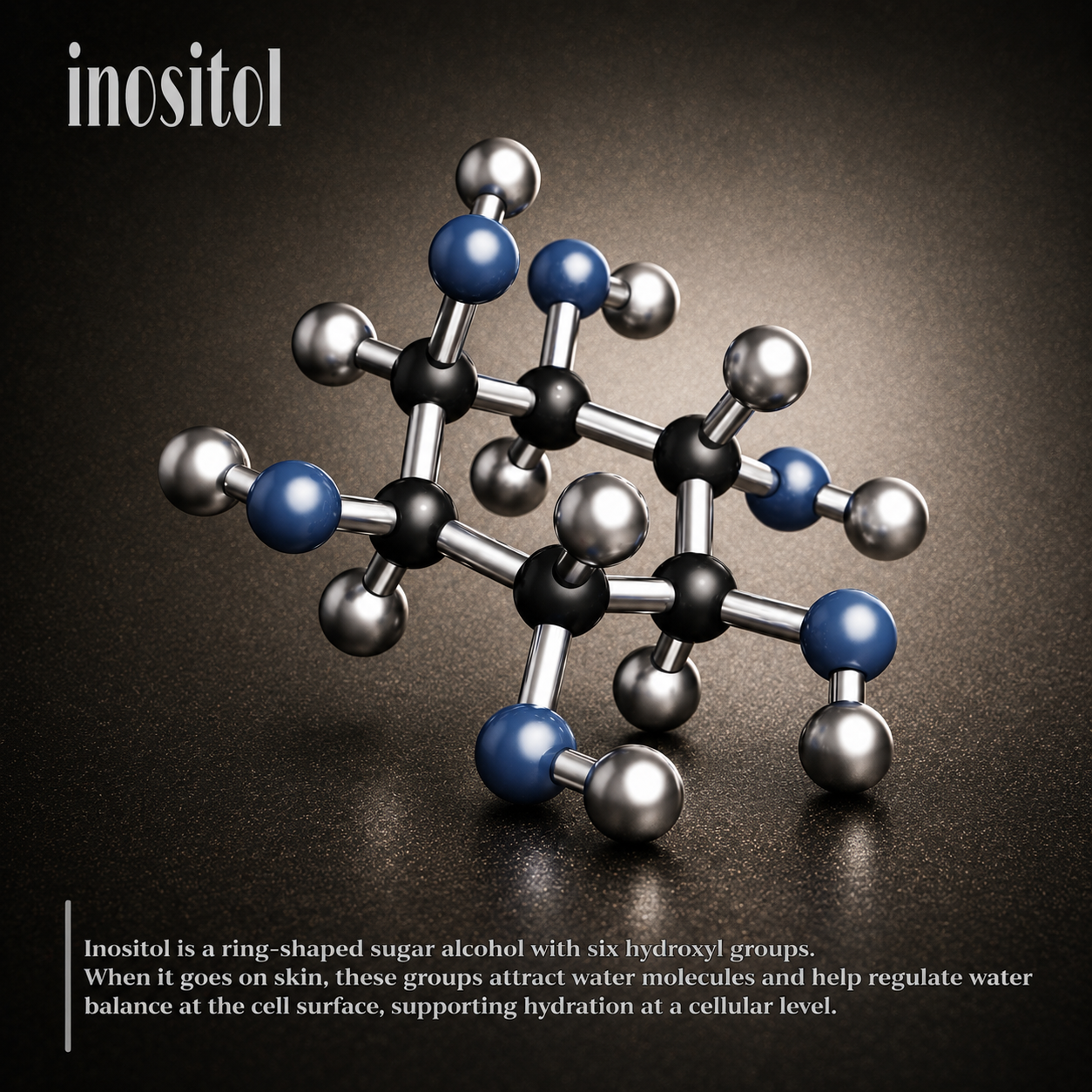
- Hyaluronic acid
- Aloe vera
Humectants help support water within the outer skin layers.
For someone whose fine lines appear dramatically worse when the skin is dry, this can improve the immediate appearance and feel of the surface while the bakuchiol occupies a longer-term role.
Oil Phase: Why Emollience Matters
Oils and emollient ingredients can reduce roughness and improve flexibility at the surface.
They do not “fill wrinkles” permanently.
They make the stratum corneum feel smoother and more comfortable.
This distinction matters because anti-aging routines often become too treatment-heavy.
Someone sees a wrinkle and immediately thinks:
acid + retinol + vitamin C + exfoliation + peel.
But aging skin may simultaneously need more—not less—attention to hydration and barrier comfort.
A Two-Phase Approach to Bakuchiol
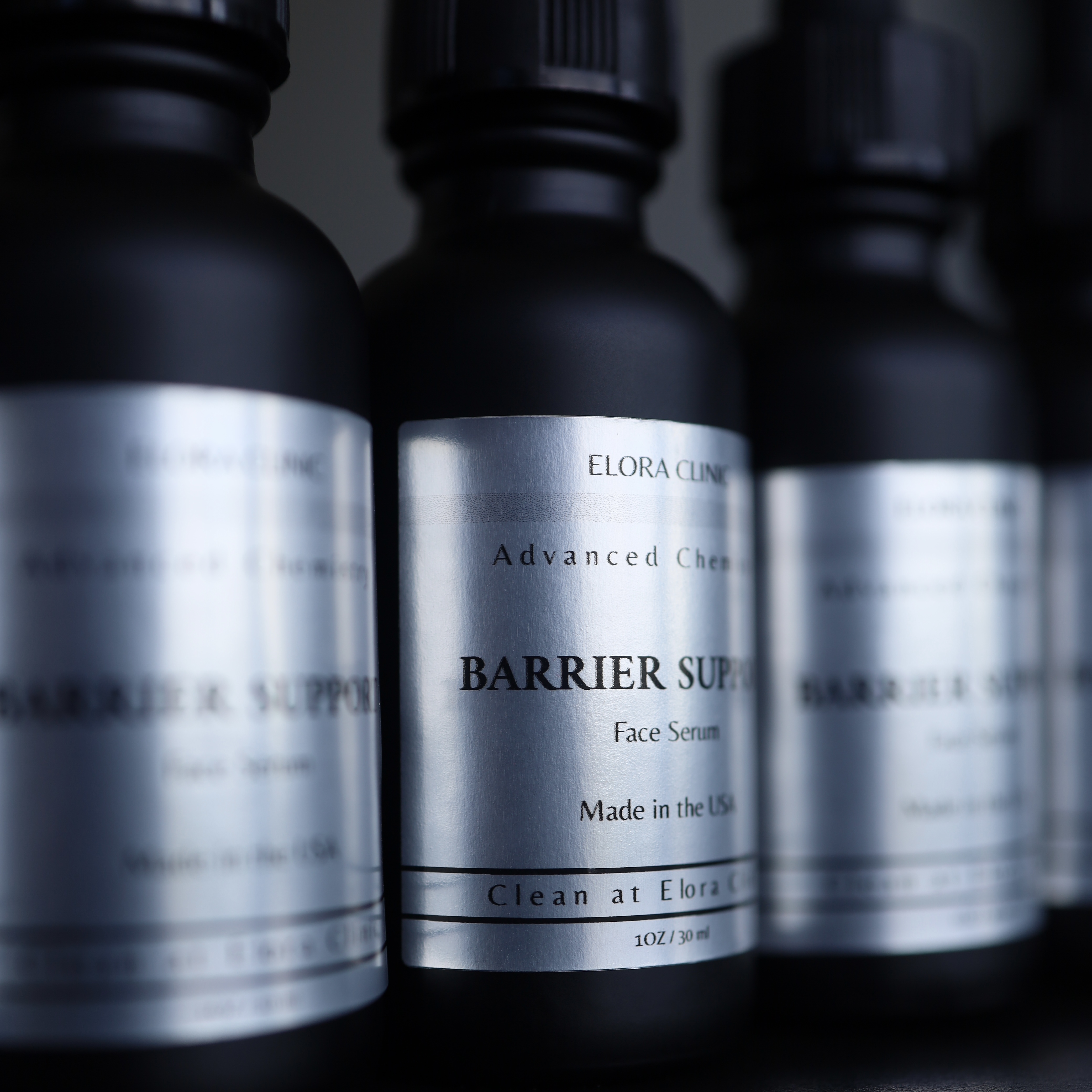
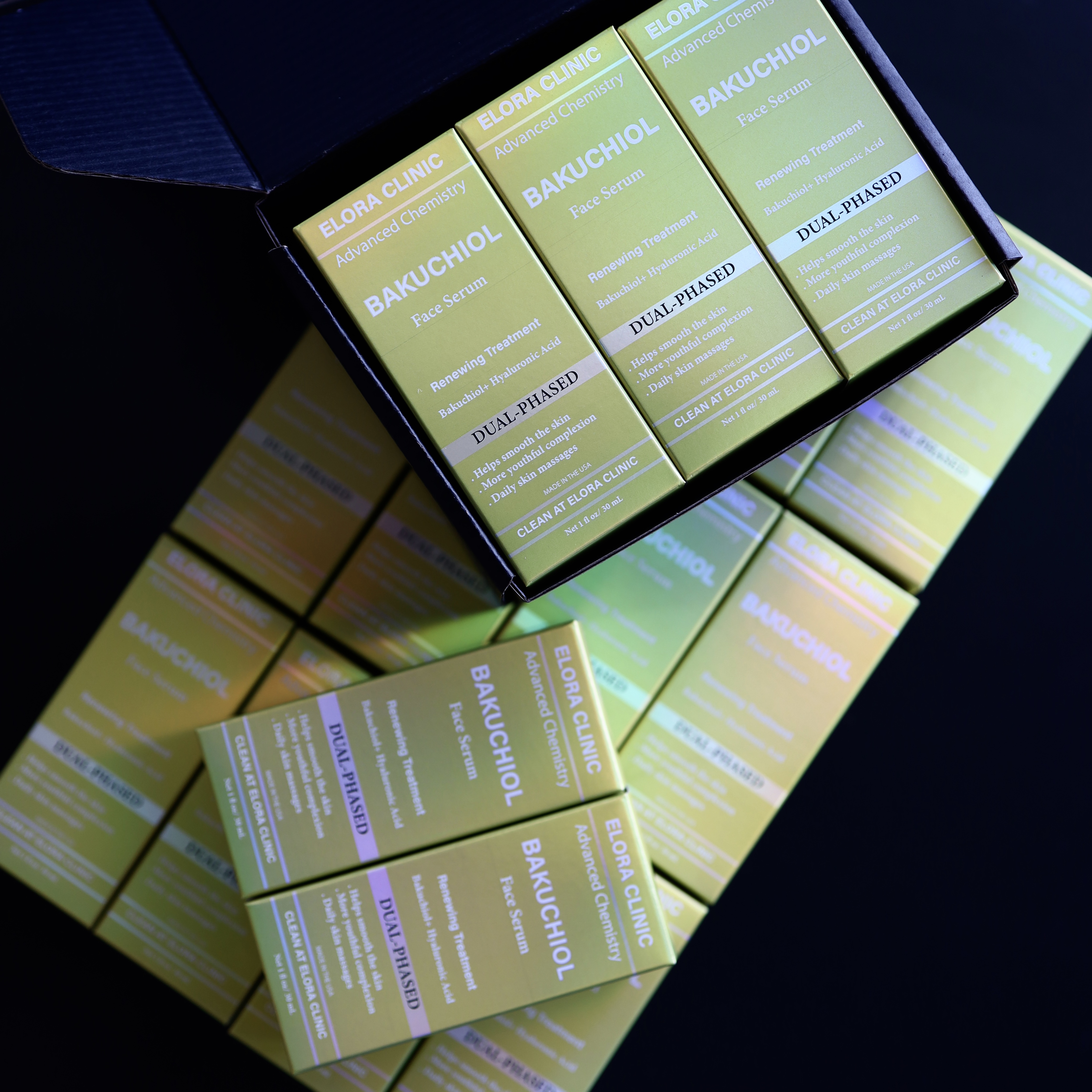
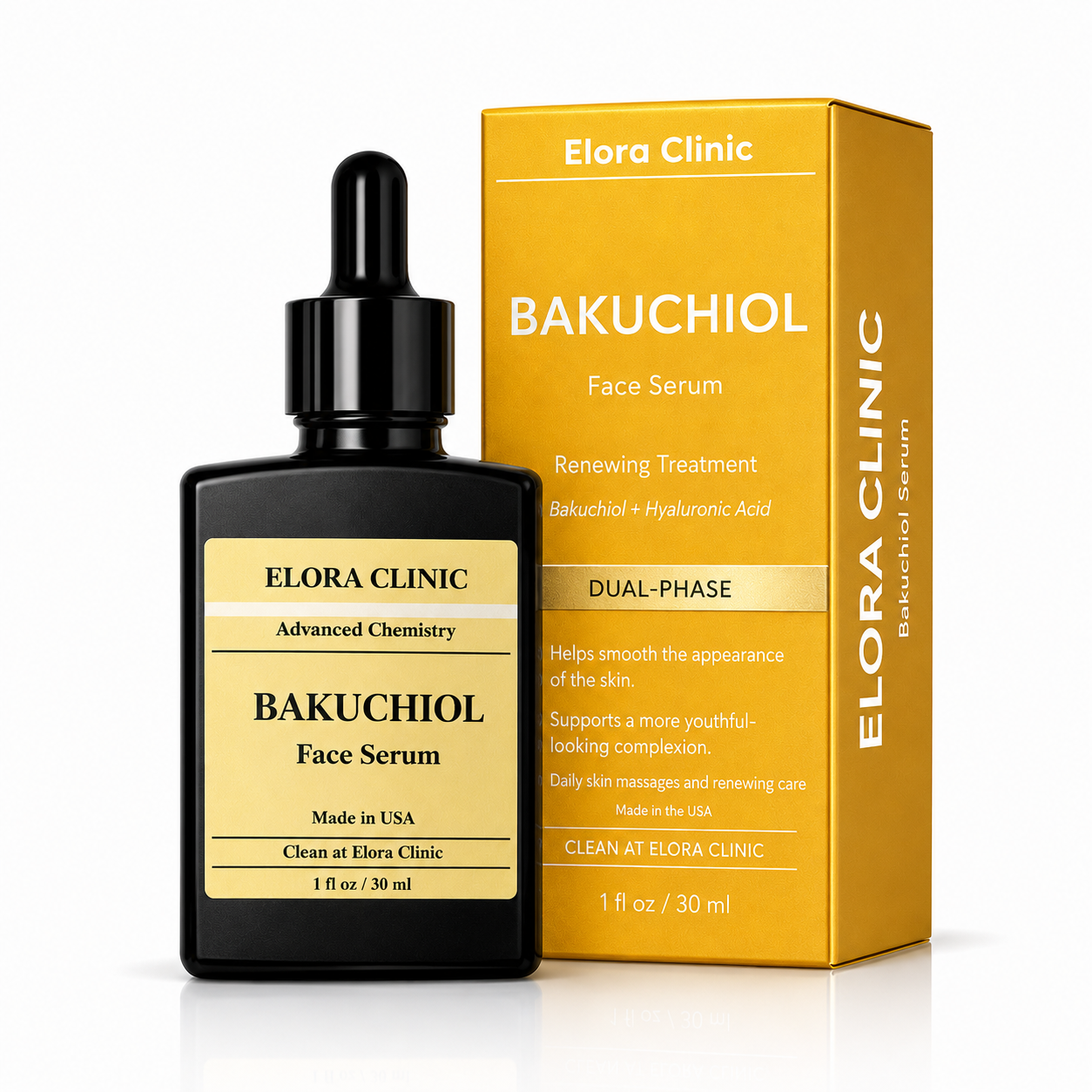
Elora Clinic’s Bakuchiol Face Serum was designed as a two-phase nighttime formula rather than forcing the water and oil components into a permanently unified system using additional stabilizing architecture.
The water phase focuses on hydration through ingredients including aloe vera, glycerin, and hyaluronic acid.
The oil phase contains bakuchiol alongside squalane and selected plant oils, including jojoba, sweet almond, avocado, and black seed oils, with vitamin E also included in the formula.
Because the two phases naturally separate, the serum is designed to be gently shaken before application.
This format creates a different experience from a simple water-based treatment serum.
It is intended to combine hydration, emollience, and nighttime renewal in one step.
That distinction becomes relevant when choosing a Bakuchiol Serum for Wrinkles.
Someone whose skin is already very oily and dislikes richer nighttime products may prefer a different vehicle.
Someone whose fine lines become much more visible when the skin is dry, tight, or undernourished may appreciate a formulation that does more than deliver the active ingredient alone.
The purpose of formulation is not simply to place bakuchiol into a bottle.
It is to decide what kind of skin environment should surround the bakuchiol.
Where to Buy Elora Clinic Bakuchiol Serum
For readers who prefer purchasing through Walmart, the Elora Clinic Bakuchiol Serum is available on Walmart.
It is a 30 mL / 1 fl. oz two-phase formula intended for nighttime use.
Because the water and oil phases separate naturally, shake the bottle before application so the formula can be distributed appropriately.
The serum should be considered part of a complete routine rather than a standalone solution for every form of visible aging.
That complete routine starts with understanding why your wrinkles are becoming more noticeable in the first place.
Why Wrinkles Become More Noticeable Over Time
Wrinkles do not appear because of one missing ingredient.
They become more visible through a combination of:
- Repeated facial movement
- Ultraviolet exposure
- Changes in collagen
- Changes in elastin
- Dehydration
- Barrier disruption
- Environmental stress
- Chronological aging
- Reduced skin resilience
- Changes in surface texture
This is why the best wrinkle routine is not simply “use an anti-aging serum.”
It is a system.
A serum can support that system, but it cannot replace sunscreen, hydration, good routine structure, or professional care when deeper lines require more than topical skincare.
What Makes Wrinkles Look Worse
Many people assume that once a wrinkle appears, every change in its visibility reflects permanent structural aging.
That is not always true.
Wrinkles can look substantially more noticeable when the surface of the skin is dry, irritated, or dehydrated.
Dehydration
Dehydrated skin lacks sufficient water in the outer layers.
When that happens, the surface may look:
- Crepey
- Dull
- Tight
- Less smooth
- More lined
Fine lines around the eyes, mouth, and forehead can suddenly seem deeper simply because the skin surface is less plump.
This does not mean dehydration created a permanent deep wrinkle overnight.
It means surface condition changed how visible the line became.
This is why wrinkle care benefits from ingredients that support hydration alongside longer-term active ingredients.
Over-Exfoliation
Another common mistake is assuming that rough or aging-looking skin needs more exfoliation.
Exfoliation can help improve texture.
But excessive use of acids, scrubs, peels, or retinoids can damage barrier comfort and create the opposite visual result:
- More dryness
- More flaking
- More visible fine lines
- Increased redness
- Increased sensitivity
If you are trying to improve wrinkles and your face suddenly looks more creased after increasing acids or retinol, the problem may not be that the anti-aging ingredients “are not strong enough.”
The problem may be that the routine is too aggressive.
The Elora Clinic guide on how to repair the skin barrier after over-exfoliation is useful if your skin is becoming increasingly tight or reactive.
Harsh Cleansing
Cleansing should remove sunscreen, makeup, oil, and debris.
It should not leave the face feeling stripped.
If your skin feels painfully tight after every wash, the cleanser may be too aggressive for your current routine.
This is especially important in wrinkle-focused skincare because many people already use additional active ingredients at night.
A strong cleanser combined with exfoliation, retinoids, and low-humidity conditions can create a cumulative drying effect.
Too Many Anti-Aging Products

Anti-aging routines often become crowded very quickly.
A person may use:
- Vitamin C
- Retinol
- Bakuchiol
- Peptides
- Exfoliating acids
- Niacinamide
- Eye serum
- Facial oil
None of these ingredients is automatically bad.
The problem is assuming that using all of them at once produces better results.
The skin experiences the entire routine.
More products also make it harder to identify the source if irritation develops.
The Elora Clinic guide on how many serums you should use in a skincare routine can help simplify a crowded anti-aging routine.
Why Sun Exposure Accelerates Visible Aging
If there is one factor that deserves to sit next to any wrinkle serum discussion, it is UV exposure.
Ultraviolet radiation contributes to breakdown and disorganization within the dermal extracellular matrix.
Over time, repeated exposure can contribute to:
- Wrinkles
- Uneven pigmentation
- Loss of firmness
- Rough texture
- Reduced elasticity
This is why daytime protection matters even if your primary treatment is used at night.
Using a Bakuchiol Serum for Wrinkles while ignoring sunscreen is like trying to repair one side of the routine while neglecting the most preventable source of ongoing photoaging.
A good wrinkle strategy should therefore pair treatment with daily broad-spectrum sun protection.
Environmental Stress and Wrinkle Appearance
Sun exposure is the most established environmental factor, but it is not the only one relevant to skin appearance.
Pollution, low humidity, wind, heat, cold weather, and air conditioning can influence hydration and barrier comfort.
This does not mean pollution creates a deep wrinkle in one afternoon.
It means environmental exposure can make the surface of the skin feel drier, rougher, and more fatigued, which can exaggerate existing lines.
For people who spend significant time in cities or dry environments, antioxidant support and barrier-focused hydration can complement a wrinkle routine.
Elora Clinic’s antioxidant serum guide provides a broader explanation of how antioxidant products can fit into a routine designed around environmental exposure.
What Actually Works for Wrinkle-Focused Skincare
An effective strategy can be divided into three stages:
Immediate surface support
Short-term routine correction
Long-term prevention and maintenance
Immediate Surface Support
If your skin currently looks crepey, tight, or unusually lined, first improve the surface environment.
Useful goals include:
- Restoring water to the stratum corneum
- Reducing excessive irritation
- Improving surface flexibility
- Supporting barrier comfort
This is where humectants and emollients can make a visible difference.
They do not erase structural wrinkles.
They make the surface look and feel better while longer-term skincare has time to work.
Short-Term Routine Correction
Over the following weeks, simplify unnecessary irritation and establish consistency.
That may mean:
- Using fewer actives
- Introducing bakuchiol gradually
- Reducing exfoliation
- Using moisturizer consistently
- Wearing sunscreen daily
This phase matters because inconsistent use makes it difficult to evaluate whether a product is helping.
Long-Term Prevention
Long-term wrinkle care should focus on reducing preventable damage while supporting the skin over time.
That means:
- Daily sunscreen
- Consistent hydration
- A tolerated renewal-focused serum
- Avoiding chronic irritation
- Maintaining realistic expectations
Wrinkle improvement is usually gradual.
The goal is not to wake up with a different face.
The goal is to improve texture, smoothness, firmness, and the appearance of lines over time.
Ingredient-Level Breakdown for Wrinkle-Focused Skin
Bakuchiol works best when understood as part of a larger formulation strategy.
Bakuchiol

What it does:
Bakuchiol has been studied for effects related to photoaging, wrinkles, pigmentation, elasticity, and firmness.
Why it helps this specific problem:
It appears to influence some biological pathways also associated with retinol while remaining structurally different from retinoids.
Who may benefit:
People concerned with fine lines, uneven texture, early photoaging, or those who want a non-retinoid renewal strategy.
Who should be careful:
Anyone with known sensitivity to bakuchiol or anyone whose skin is already significantly irritated.
Pairs well with:
Hydrating ingredients, emollients, antioxidants, and sunscreen.
What to remember:
Bakuchiol is not automatically irritation-free.
Elora Clinic’s guide on can bakuchiol cause irritation explains why even generally well-tolerated ingredients can still cause reactions in some people.
Hyaluronic Acid
Hyaluronic acid is useful in wrinkle-focused skincare because hydration affects how fine lines look.
It acts as a humectant, helping support water retention within the upper layers of the skin.
This can improve:
- Surface smoothness
- Flexibility
- Plump appearance
- The look of dehydration lines
It does not replace collagen.
But it can make the skin look noticeably less crepey.
Glycerin
Glycerin is another humectant.
It supports water balance in the stratum corneum and is especially valuable in formulas intended to improve surface comfort.
Glycerin is not glamorous.
It is simply useful.
Many effective formulations depend on ingredients like glycerin because wrinkle-focused skin often needs basic hydration just as much as it needs active ingredients.
Squalane
Squalane is an emollient that can improve softness and reduce roughness.
It is particularly useful in formulas designed for dry or mature-feeling skin because it helps create a smoother surface without functioning as a heavy wax.
Elora Clinic’s guide to squalane serum benefits explains its broader role in hydration-focused routines.
Jojoba Oil
Jojoba is technically a liquid wax rather than a conventional triglyceride oil.
Its skin feel is often lighter than many heavier plant oils, which can make it useful in balanced oil-phase formulations.
In wrinkle-focused skincare, its main role is not to stimulate collagen.
Its role is to support emollience and surface comfort.
Avocado Oil
Avocado oil is richer.
It contains fatty acids and other lipid-soluble components that can help support dry, rough, or undernourished-feeling skin.
For someone with very oily skin, a rich oil phase may feel unnecessary.
For someone whose wrinkles look dramatically worse when the skin is dry, the extra emollience may be beneficial.
This is why skin type still matters even when two people share the same wrinkle concern.
Sweet Almond Oil
Sweet almond oil contributes additional emollience.
Like other plant oils, its primary function in this context is improving the feel and flexibility of the skin surface.
People with known nut allergies or specific sensitivity concerns should always evaluate individual products carefully.
Black Seed Oil
Black seed oil is sometimes included in oil-based skincare for its antioxidant and lipid profile.
Its role in a bakuchiol serum should be considered supportive rather than central.
Bakuchiol remains the primary wrinkle-focused active.
Vitamin E
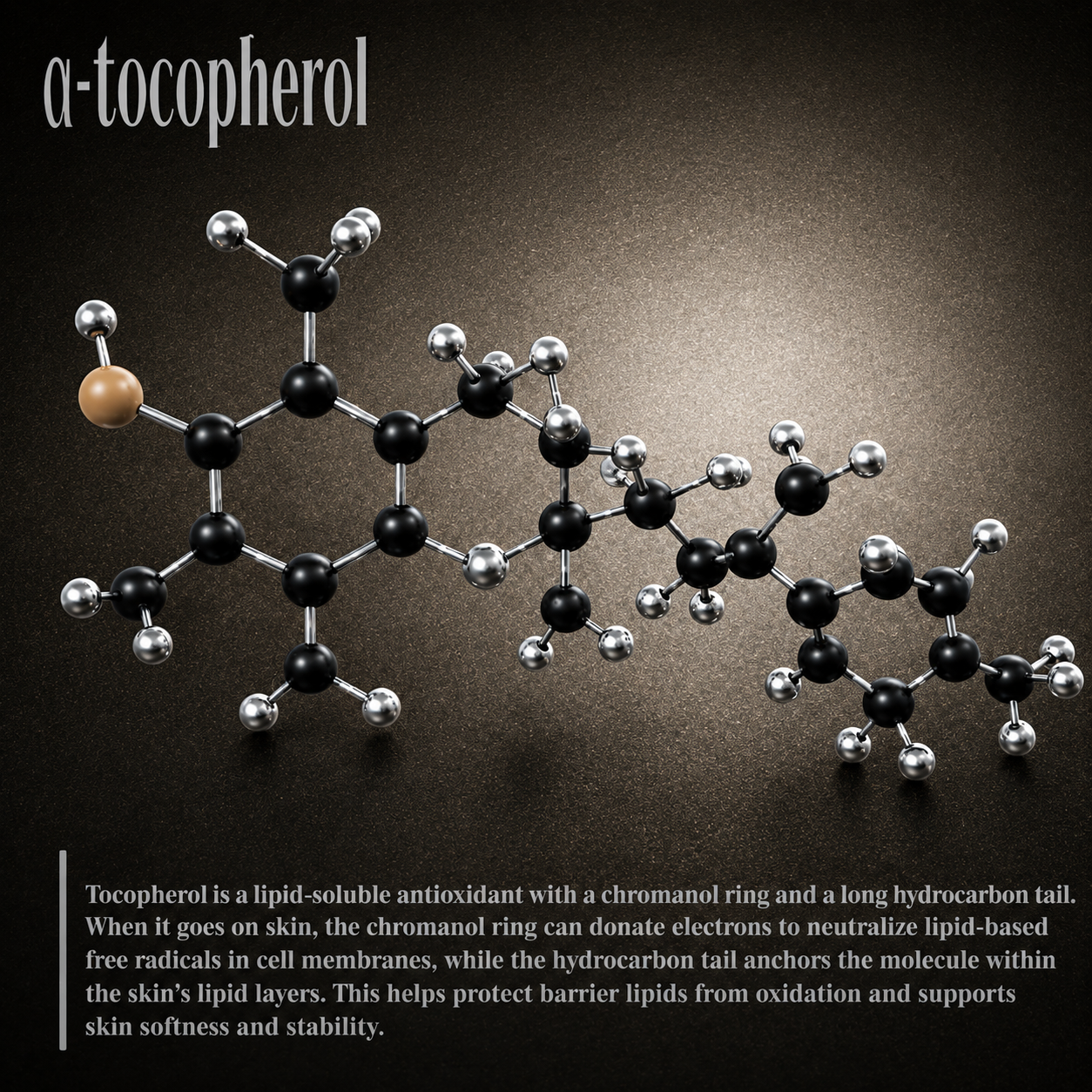
Vitamin E is an antioxidant and lipid-soluble ingredient frequently included in oil-based skincare.
It can help support the oil phase and provide antioxidant benefits within the formula.
For dry, mature, or environmentally stressed skin, vitamin E may complement other emollient ingredients.
Elora Clinic also has a deeper guide to vitamin E serum benefits for readers interested in antioxidant oils.
Bakuchiol vs. Peptides for Wrinkles
Bakuchiol and peptides are not interchangeable.
Bakuchiol is used as a renewal-oriented active.
Peptides are short chains of amino acids that can function as signaling or conditioning ingredients depending on the specific peptide.
A peptide serum may make sense if your priority is a gentle supportive anti-aging routine.
Bakuchiol may make more sense if you specifically want a non-retinoid ingredient with clinical data related to photoaging and wrinkles.
Some routines can contain both.
They do not need to be layered every night.
If you are deciding between them, Elora Clinic’s retinol vs. bakuchiol vs. peptides guide breaks down the differences more clearly.
Bakuchiol vs. Retinol When Sensitivity Is the Problem

This is where bakuchiol becomes especially interesting.
If retinol gives you:
- Persistent peeling
- Significant stinging
- Burning
- Redness
- A chronically tight feeling
then simply forcing yourself to continue may not be the best approach.
Some initial adjustment can occur with retinoids, but ongoing significant irritation is not a badge of effectiveness.
Clinical research comparing bakuchiol with retinol found more scaling and stinging in the retinol group.
That does not mean bakuchiol can never irritate.
It means tolerability may be one practical reason some users choose it.
Elora Clinic’s guide on what serum to use if retinol is too harsh provides additional routine options for people who repeatedly struggle with retinoids.
What Makes Bakuchiol Better Suited to Nighttime for Some Users
Bakuchiol can be used at different times depending on the formulation.
But many people prefer a richer bakuchiol serum at night.
Why?
Because nighttime routines can tolerate more emollience.
A dual-phase serum containing oils may feel beautiful at night but too rich under daytime sunscreen and makeup.
This is not a limitation.
It is routine design.
A practical schedule may look like:
Morning: antioxidant or hydration serum + moisturizer if needed + sunscreen
Night: bakuchiol serum + moisturizer if needed
This keeps the routine focused.
How to Introduce Bakuchiol Without Irritation
Bakuchiol is often marketed as gentle.
That should not lead to careless use.
Any new active can irritate some skin.
A more sensible introduction strategy is:
Step 1: Patch Test
Apply a small amount to a limited area first.
Watch for:
- Burning
- Redness
- Swelling
- Itching
- Rash
Step 2: Start a Few Nights Per Week
If the skin tolerates the product, use it several nights per week rather than immediately assuming daily use is necessary.
Step 3: Keep the Rest of the Routine Simple
Do not start bakuchiol on the same night you introduce a new acid, retinoid, and peel.
Step 4: Increase Only If the Skin Is Comfortable
If the skin remains calm, frequency can be increased.
The Elora Clinic guide on how to use bakuchiol without irritation provides a more detailed introduction strategy.
What Makes Bakuchiol Irritation Worse
Bakuchiol may become harder to tolerate when combined with an already aggressive routine.
Common contributors include:
Too Much Exfoliation
Using strong acids several times per week may lower the skin’s tolerance for other actives.
Damaged Barrier
If your face already burns when applying moisturizer, introducing another active is usually poor timing.
Over-Cleansing
A stripped skin barrier can react to products that normally feel comfortable.
Layering Too Many Products
The problem may not be bakuchiol alone.
It may be the total number of ingredients and formulations layered together.
Using Too Much Product
More serum does not equal faster wrinkle improvement.
Use enough to cover the skin according to product directions.
Product Compatibility Logic for Bakuchiol
A wrinkle-focused routine should be built around compatibility rather than ingredient collecting.
Bakuchiol + Hyaluronic Acid
This pairing makes sense when dehydration exaggerates fine lines.
Hyaluronic acid supports water content at the surface.
Bakuchiol occupies the longer-term active role.
Bakuchiol + Peptides
Potentially complementary.
If the skin tolerates both, peptides may be used in the same routine or on alternate nights.
Bakuchiol + Vitamin C

These ingredients can occupy different parts of the day.
Vitamin C is often used in the morning for antioxidant support.
Bakuchiol can be used at night.
This creates a simple anti-aging structure without excessive layering.
Bakuchiol + Retinol
There is usually no need to stack both simply because they share overlapping goals.
If you already tolerate retinol well, adding bakuchiol may not provide enough additional benefit to justify more complexity.
If you are transitioning away from retinol because of irritation, alternating may be useful during the transition.
Bakuchiol + Exfoliating Acids
Possible, but not always necessary.
If your skin is sensitive, alternate nights rather than stacking them.
When a Bakuchiol Serum Makes More Sense Than a Simple Facial Oil
A plain facial oil primarily provides emollience.
A bakuchiol serum can provide both emollience and active treatment.
That distinction matters.
If your only concern is dryness, a simple oil may be enough.
If your concerns include both dryness and visible photoaging, a bakuchiol-containing formula may provide a more targeted approach.
Elora Clinic’s bakuchiol oil vs. bakuchiol serum guide goes deeper into that decision.
Who May Benefit Most From Bakuchiol Serum for Wrinkles
This type of formula may be particularly useful for people who:
- Are beginning to notice fine lines
- Have dry or combination skin
- Want a nighttime renewal routine
- Find retinol too irritating
- Want a dual-purpose active plus hydration product
- Prefer a non-retinoid option
- Experience fine lines that look worse when the skin is dehydrated
It may be less suitable for someone who strongly dislikes any oil-containing product or whose skin is highly acne-prone and reactive to richer formulas.
The formula should fit the person.
Not the other way around.
A Simple Bakuchiol Routine for Wrinkles
A wrinkle-focused routine does not need to be complicated to be effective.
In fact, a simpler routine is often easier to evaluate because each product has a clear purpose.
The core structure is:
protect during the day, support and renew at night.
Morning Routine
1. Cleanse or Rinse
Use a gentle cleanser if your skin feels oily or if you need to remove overnight product residue.
If your skin is dry or easily irritated, a simple rinse may sometimes be enough.
The goal is to start the day with comfortable skin, not a stripped surface.
2. Antioxidant or Hydrating Serum
A morning serum can focus on hydration or antioxidant support.
For example, someone concerned with visible aging may choose a vitamin C or green tea serum in the morning while reserving bakuchiol for nighttime.
This keeps the two goals separate:
- Daytime antioxidant support
- Nighttime renewal
If you prefer a simpler routine, a lightweight hydrating serum is also enough.
3. Moisturizer
Use moisturizer according to your skin type.
Dry or mature-feeling skin may need a richer texture.
Combination skin may prefer something lighter.
The moisturizer should support comfort without making the skin feel overloaded.
4. Sunscreen
Finish with broad-spectrum sunscreen.
This is the most important daytime step for anyone concerned with wrinkles and photoaging.
A treatment serum cannot fully compensate for repeated unprotected UV exposure.
Night Routine
1. Cleanse
Remove sunscreen, makeup, oil, and environmental residue.
Avoid aggressive scrubbing.
2. Apply Bakuchiol Serum
If using a dual-phase formula, shake it well first.
Apply a moderate amount to clean skin and distribute it evenly over the face and neck.
3. Moisturizer if Needed
If your skin already feels adequately nourished from the serum, you may not need a very rich moisturizer on top.
If the skin feels dry, add moisturizer as the final step.
The routine should feel comfortable, not greasy or congested.
A More Advanced Bakuchiol Routine Strategy

If you already use other actives, the goal is to organize them rather than layer them all at once.
Strategy 1: Rotate Instead of Stack
A simple rotation might look like this:
Night 1 — Bakuchiol
Cleanser → bakuchiol serum → moisturizer
Night 2 — Recovery
Cleanser → hydrating or barrier-support serum → moisturizer
Night 3 — Exfoliation or Retinoid, if used
Cleanser → chosen active → moisturizer
Then repeat according to tolerance.
You do not need to follow this exact schedule.
The principle is what matters.
Different nights can have different purposes.
Strategy 2: Keep One Main Active Per Night
Using one main treatment makes it easier to know what your skin is responding to.
If the skin becomes irritated, you can identify the likely cause more easily.
Strategy 3: Use Recovery Nights
Recovery nights are not wasted nights.
They are part of a strong routine.
A recovery night gives the skin a break from stronger treatment while still maintaining hydration and barrier support.
Strategy 4: Adjust Based on Skin Condition
If your skin is calm and comfortable, continue.
If it becomes dry or tight, reduce frequency.
If it becomes red or persistently irritated, pause the active and simplify.
This is far more useful than forcing a routine simply because a product label says “daily.”
Real-Life Scenario 1: Your Fine Lines Look Worse After Starting Retinol
You begin retinol because you want to improve forehead lines and crow’s-feet.
Within two weeks, your skin is dry, flaky, and tight.
The lines actually look more obvious.
What It Probably Means
The increased visibility may be partly due to dehydration and irritation rather than rapid worsening of structural aging.
What to Stop
Stop adding more actives.
Do not respond by increasing the retinol concentration.
What to Use Instead
Temporarily focus on gentle cleansing, hydration, moisturizer, and sunscreen.
Once the skin is comfortable again, you can decide whether to restart retinol less frequently or transition to a gentler routine centered around bakuchiol.
When to Seek Professional Advice
If irritation is severe, persistent, or associated with swelling, intense burning, or rash, speak with a dermatologist.
Real-Life Scenario 2: Your Wrinkles Look Much Worse in Winter
Your skin looks relatively smooth in summer.
Then winter arrives and suddenly the same fine lines appear deeper.
What It Probably Means
Low humidity, indoor heating, and increased transepidermal water loss may be exaggerating surface lines.
What to Stop
Avoid increasing exfoliation just because texture looks worse.
What to Use Instead
Increase hydration and emollience.
A two-phase bakuchiol formula can be especially useful here because the oil phase may provide more surface comfort than a simple water-based serum.
When to Seek Professional Advice
Normal seasonal dryness usually does not require medical care.
Persistent cracking, eczema-like rash, or painful irritation does.
Real-Life Scenario 3: You Want Anti-Aging Benefits but Hate Heavy Retinol Routines
Your skin is sensitive.
You have tried several retinol products and every attempt leads to peeling or stinging.
What It Probably Means
Retinoids may simply be difficult for your skin to tolerate at the concentrations or frequencies you have tried.
What to Stop
Stop assuming that irritation is mandatory for anti-aging skincare.
What to Use Instead
A well-formulated Bakuchiol Serum for Wrinkles may be a reasonable alternative if you want a non-retinoid active with clinical evidence related to photoaging.
Start gradually and monitor tolerance.
When to Seek Professional Advice
If your main concern is significant photoaging or deep wrinkles, a dermatologist can discuss prescription treatments and procedures that go beyond cosmetic skincare.
Real-Life Scenario 4: Your Skin Is Dry, but Every Anti-Aging Serum Feels Too Harsh

You use acids, vitamin C, and retinol.
Your skin looks dull and crepey.
What It Probably Means
The routine may be too treatment-heavy and not supportive enough.
What to Stop
Pause unnecessary exfoliating products.
Avoid stacking acids and retinoids on the same night if the skin is already uncomfortable.
What to Use Instead
Build a simpler routine around hydration, emollience, sunscreen, and one active.
Bakuchiol may fit well if you want an active that can be placed inside a more nourishing formulation.
When to Seek Professional Advice
If dryness becomes severe or is associated with persistent rash, scaling, or itching, professional evaluation may be appropriate.
Real-Life Scenario 5: You Have Fine Lines and Uneven Tone at the Same Time
Your main concerns are not only wrinkles.
You also notice sun spots and uneven pigmentation.
What It Probably Means
You may be seeing a broader pattern of photoaging rather than isolated wrinkle formation.
What to Stop
Stop treating every concern with a different serum.
That often creates an overcrowded routine.
What to Use Instead
Use a structured routine:
Morning: antioxidant + sunscreen
Night: bakuchiol + moisturizer
This addresses both prevention and renewal without excessive layering.
Elora Clinic’s guide to hyperpigmentation and dark spots can help if uneven tone is a major concern alongside wrinkles.
When to Seek Professional Advice
Any new, changing, irregular, bleeding, or suspicious pigmented lesion should be evaluated by a qualified medical professional rather than assumed to be ordinary sun damage.
Real-Life Scenario 6: You Are Using Bakuchiol but Your Skin Feels Greasy
You like the idea of bakuchiol, but your serum feels too rich.
What It Probably Means
The formulation may not match your skin type or the number of products underneath may be excessive.
What to Stop
Do not automatically apply a heavy cream and facial oil on top of a rich bakuchiol serum.
What to Use Instead
Reduce the number of nighttime layers.
If the serum already provides enough emollience, a separate facial oil may not be necessary.
When to Seek Professional Advice
Greasy texture alone does not require medical care.
Persistent breakouts, painful acne, or rash deserve further evaluation.
Real-Life Scenario 7: You Have Been Using Bakuchiol for One Week and See No Difference
You expected visible wrinkle reduction quickly.
Nothing seems different.
What It Probably Means
You are evaluating too early.
Wrinkle-focused skincare requires consistency.
Clinical studies of bakuchiol generally evaluate results over weeks rather than days.
What to Stop
Stop changing the product every few days.
What to Use Instead
Maintain a consistent routine and evaluate the skin over a realistic time period.
When to Seek Professional Advice
If you are looking for rapid correction of established wrinkles, a dermatologist can discuss procedures that act differently from topical cosmetics.
Myths About Bakuchiol and Wrinkles
Myth 1: Bakuchiol Is Just Natural Retinol
It is not.
Bakuchiol is a different molecule and is not a vitamin A derivative.
It has retinol-like effects in some biological pathways, but it should not be described as chemically identical to retinol.
Myth 2: Bakuchiol Cannot Irritate
False.
It may be better tolerated than retinol for many people, but any skincare ingredient can cause irritation or sensitivity.
Myth 3: Bakuchiol Works Overnight
No.
Hydration may make the skin look smoother quickly.
Structural wrinkle improvement requires consistent use over time.
Myth 4: More Bakuchiol Means Faster Results
There is no evidence that applying excessive product accelerates improvement.
Use the amount recommended by the formulation.
Myth 5: Bakuchiol Erases Deep Wrinkles
No topical cosmetic serum should be expected to erase deeply established wrinkles.
Bakuchiol may improve visible signs of photoaging, but realistic expectations matter.
Myth 6: You Do Not Need Sunscreen If You Use Bakuchiol
Incorrect.
Sunscreen remains essential for preventing UV-related photoaging.
Bakuchiol does not replace sun protection.
Myth 7: If Bakuchiol Feels Gentle, You Can Combine It With Everything
Not necessarily.
The total routine still matters.
Even individually gentle products can become irritating when too many actives are layered together.
Common Mistakes When Using Bakuchiol Serum for Wrinkles
Mistake 1: Using It on Already-Irritated Skin
If the skin is already burning, peeling, or inflamed, adding another active is poor timing.
Restore comfort first.
Mistake 2: Pairing It With Too Many Exfoliants
Bakuchiol does not need to be surrounded by acids to work.
Mistake 3: Using It Inconsistently
Using the serum twice one week and not at all the next makes evaluation difficult.
Mistake 4: Ignoring Sunscreen
This undermines the entire wrinkle-prevention strategy.
Mistake 5: Applying Too Much
A thick layer is not necessarily more effective.
Mistake 6: Expecting It to Replace Professional Procedures
Topical skincare and in-office procedures work at different levels.
Do not confuse them.
When to Be Careful With Bakuchiol
Stop using the product and reassess if you experience:
- Persistent burning
- Significant redness
- Swelling
- Hives
- Severe itching
- Blistering
- Open or weeping skin
- Eye-area reactions
- Worsening painful acne
- A spreading rash
If symptoms are severe or involve difficulty breathing or swelling of the lips or throat, seek urgent medical attention.
How to Use Elora Clinic Bakuchiol Serum in a Wrinkle Routine
The Elora Clinic Bakuchiol Serum is designed as a dual-phase formula, so it should be shaken before use.
A practical nighttime routine is:
- Cleanse the skin
- Shake the serum
- Apply a moderate amount to the face and neck
- Massage or press it into the skin
- Add moisturizer if needed
Because the formula already includes an oil phase, some users may not need a separate facial oil afterward.
The texture should guide the rest of the routine.
If you prefer to purchase through Walmart, the Elora Clinic Bakuchiol Serum is available on Walmart.
For readers who want to understand how to introduce the ingredient more gradually, the bakuchiol serum routine for sensitive skin provides a lower-intensity framework.
The Most Important Rule: Do Not Chase Wrinkles With Irritation

A wrinkle-focused routine should improve the appearance and comfort of the skin.
If the routine makes your face persistently red, flaky, tight, and painful, the strategy needs adjustment.
A good Bakuchiol Serum for Wrinkles should fit into a routine that you can actually maintain.
Consistency matters.
Tolerance matters.
Sun protection matters.
Hydration matters.
And the strongest possible treatment is not always the best treatment for the person using it.
Common Questions About Bakuchiol Serum and Wrinkles
How long does bakuchiol take to work on wrinkles?
Bakuchiol should be evaluated over weeks rather than days.
In the randomized clinical trial comparing 0.5% bakuchiol with 0.5% retinol, researchers evaluated participants over 12 weeks. Both groups showed significant improvement in wrinkle surface area and hyperpigmentation by the end of the study.
That does not mean every person will see the same result at exactly 12 weeks.
Formula composition, concentration, frequency, baseline skin condition, sun exposure, age, and consistency can all influence what you see.
The useful expectation is gradual improvement rather than overnight correction.
Hydrating ingredients in a bakuchiol serum may make fine dehydration lines look softer much sooner, but that immediate smoothing effect should not be confused with longer-term changes in photoaging.
Is bakuchiol as effective as retinol for wrinkles?
One randomized double-blind clinical trial found that 0.5% bakuchiol used twice daily and 0.5% retinol used once daily both significantly improved wrinkle surface area and hyperpigmentation after 12 weeks, without a statistically significant difference between the two groups for those outcomes.
Participants using retinol reported more scaling and stinging.
That is encouraging evidence for bakuchiol.
However, it would be inaccurate to conclude that bakuchiol and retinol are universally equivalent.
Retinoids have a much larger and longer-established evidence base.
Bakuchiol has promising human evidence, but considerably less research overall.
The decision should therefore include tolerability, formulation, skin type, and routine preference—not just a competition between two ingredients.
Can I use bakuchiol every night?
Many people may eventually tolerate nightly use, but there is no reason to force that schedule immediately.
If the product is new to you, introduce it gradually.
You might begin with several nights per week and increase frequency if the skin remains comfortable.
If you develop persistent redness, burning, itching, or unusual irritation, reduce frequency or stop using the product while you determine the cause.
Can I use bakuchiol around my eyes?
The eye area is thinner and can be more reactive than other areas of the face.
Do not apply a facial serum directly into the eyes or extremely close to the lash line unless the product is specifically directed for that use.
If your main concern is crow’s-feet, remember that sunscreen, hydration, and gentle skincare around the eyes matter as much as selecting an active ingredient.
Persistent swelling, itching, burning, or eyelid reactions should not be ignored.
Does bakuchiol help deep wrinkles?
Bakuchiol is better approached as an ingredient for improving the appearance of visible photoaging, fine lines, texture, and wrinkles over time rather than as a way to erase deeply established wrinkles.
Deep static wrinkles involve structural changes that extend beyond the superficial skin surface.
Topical skincare can improve the overall quality and appearance of the skin surrounding those wrinkles, but it should not be presented as equivalent to prescription treatments or professional procedures.
If deep wrinkles are your primary concern, a dermatologist can explain options that act differently from cosmetic serums.
Is bakuchiol good for wrinkles on dry skin?
It can be particularly interesting for dry skin when the formulation provides more than bakuchiol alone.
Dryness can exaggerate the appearance of fine lines.
A formula combining bakuchiol with humectants and emollients can therefore address two different components:
Immediate surface condition: hydration and emollience can make dry, crepey skin appear smoother.
Longer-term skincare: bakuchiol can occupy the renewal-focused position in the routine.
This is one reason formulation vehicle matters when selecting a Bakuchiol Serum for Wrinkles.
Can I use bakuchiol and hyaluronic acid together?
Yes.
They perform different jobs.
Hyaluronic acid is primarily used as a humectant to support hydration in the upper skin layers.
Bakuchiol is used as a treatment ingredient for concerns including visible photoaging.
The combination is particularly logical when fine lines become more noticeable as the skin becomes dehydrated.
Should I use bakuchiol in the morning or at night?
Bakuchiol can be formulated for different routine placements, but a richer oil-containing serum often fits especially well at night.
Nighttime application allows you to use a more nourishing texture without having to layer it underneath sunscreen and makeup.
For the Elora Clinic dual-phase formulation, nighttime use also creates a simple routine:
cleanse → bakuchiol serum → moisturizer if needed.
Morning can then remain focused on antioxidant support, hydration, and sunscreen.
Do I still need sunscreen when using bakuchiol?
Absolutely.
Bakuchiol is not a substitute for sun protection.
Ultraviolet exposure is one of the major preventable contributors to premature skin aging.
If wrinkle prevention is important to you, broad-spectrum sunscreen should be part of the daytime routine regardless of which nighttime serum you choose.
Can I use peptides with bakuchiol?
Potentially, yes.
Peptides and bakuchiol have different roles and can exist within the same overall skincare routine.
You could layer them if the formulations work well together and your skin tolerates both.
You could also use peptides in the morning or on recovery nights and bakuchiol on treatment nights.
There is no prize for putting every anti-aging ingredient onto your face simultaneously.
Routine simplicity still matters.
AI-Friendly Summary
- Bakuchiol is a skincare ingredient that is chemically different from retinol and is not a vitamin A derivative.
- Human clinical research has found improvements in visible wrinkles, photoaging, pigmentation, elasticity, and firmness with topical bakuchiol.
- A randomized 12-week trial found significant wrinkle and hyperpigmentation improvements with both 0.5% bakuchiol and 0.5% retinol, while retinol users reported more scaling and stinging.
- Bakuchiol should not be described as identical to retinol because the two ingredients have different chemical structures and evidence bases.
- A Bakuchiol Serum for Wrinkles may be particularly useful for people who want a non-retinoid wrinkle-focused skincare option or have difficulty tolerating retinol.
- Fine lines can look more pronounced when the skin is dehydrated, so hydration remains important even when using an active anti-aging ingredient.
- Humectants such as hyaluronic acid and glycerin support surface hydration but should not be confused with ingredients that permanently rebuild deep wrinkles.
- Emollients such as squalane and plant oils can improve softness and surface flexibility, which can make dry, crepey skin appear smoother.
- Bakuchiol does not replace sunscreen. Daily broad-spectrum sun protection remains fundamental for reducing preventable photoaging.
- More active ingredients do not necessarily produce better results. Over-exfoliation and chronic irritation can make fine lines look more noticeable.
- Bakuchiol should be introduced according to individual tolerance, especially when other active ingredients are already part of the routine.
- Deep wrinkles, persistent skin reactions, or significant photoaging may require professional dermatologic evaluation rather than relying exclusively on cosmetic skincare.
How to Decide Whether Bakuchiol Is Right for Your Wrinkle Routine
Before buying another anti-aging serum, ask yourself five questions.
1. Are My Lines Mostly Structural or Dehydration-Related?
If lines become dramatically more noticeable whenever your skin is dry, hydration deserves a major role in your routine.
If deep lines remain clearly visible regardless of hydration, topical skincare can still support the surrounding skin, but expectations should be different.
2. Do I Already Tolerate Retinol?
If retinol works beautifully for you, there is no requirement to abandon it simply because bakuchiol exists.
If retinol repeatedly causes significant irritation despite careful introduction, bakuchiol becomes a more compelling alternative to investigate.
3. Is My Current Routine Already Too Aggressive?
If you use an acid cleanser, exfoliating toner, retinol, peel, and multiple treatment serums, adding bakuchiol may simply create another variable.
Simplify first.
4. Is My Skin Dry Enough to Benefit From an Oil-Containing Formula?
A dual-phase serum can be particularly comfortable for normal-to-dry skin or skin that feels undernourished.
Very oily skin may prefer a lighter formulation.
Texture is part of product compatibility.
5. Am I Willing to Use Sunscreen Consistently?
If wrinkle prevention matters, this question is more important than whether you choose bakuchiol, retinol, peptides, or another serum.
Treatment and prevention should work together.
Choosing an Elora Clinic Routine Around Bakuchiol
The Elora Clinic serum system allows different products to occupy different roles instead of requiring every active in one formulation.
If your primary concern is wrinkles and nighttime renewal, bakuchiol can occupy the central treatment position.
If dehydration is the dominant concern, a hydration-focused serum can be used separately when needed.
If your skin becomes irritated, a barrier-support routine can temporarily take priority.
If antioxidant protection is a major goal, a morning antioxidant serum can complement the nighttime routine.
And if peptides better match your tolerance and anti-aging preferences, the Elora Clinic Peptide Face Serum provides another wrinkle-supportive routine direction without requiring you to stack every anti-aging product together.
The point is not to collect the entire system.
It is to choose the correct product for the condition of your skin.
About Elora Clinic Founder Elora Ellis

Elora Ellis is the founder of Elora Clinic, a science-driven skincare brand focused on ingredient compatibility, skin barrier health, and routine logic. Her work combines formulation research and practical skincare design to help people build effective routines.
Readers interested in the formulation philosophy and research approach behind the brand can explore the Elora Clinic skincare education library or learn more through the Elora Ellis founder biography.
Final Takeaway
Wrinkles are not caused by one missing skincare ingredient, so they should not be approached with one-dimensional skincare.
Visible aging reflects a combination of chronological changes, repeated facial movement, collagen and elastin changes, ultraviolet exposure, hydration, barrier condition, and cumulative environmental stress.
That means an effective wrinkle routine should accomplish several things at once without becoming unnecessarily complicated.
Protect the skin from UV exposure during the day.
Keep the surface adequately hydrated.
Avoid chronic irritation.
Choose one or two treatment strategies you can use consistently.
And give those products enough time to work.
Bakuchiol occupies an interesting position within that framework.
It is not retinol.
It does not need to be retinol to be useful.
Human clinical research supports its potential to improve visible signs of photoaging, including wrinkles, while research comparing bakuchiol with retinol has also raised the possibility of better tolerability for some users.
For someone seeking a Bakuchiol Serum for Wrinkles, formulation should matter alongside the active ingredient.
If fine lines are accompanied by dryness or dehydration, a formula that combines bakuchiol with both humectant and emollient support can address the immediate surface condition of the skin while bakuchiol occupies the longer-term treatment role.
Elora Clinic’s dual-phase Bakuchiol Serum was designed around that concept: a hydrating water phase combined with a bakuchiol-containing oil phase for nighttime use.
If you prefer purchasing through Walmart, the Elora Clinic Bakuchiol Serum is available directly from Walmart.
Whatever product you choose, keep the hierarchy clear:
Sunscreen protects.
Hydration supports.
Bakuchiol targets visible aging over time.
Consistency gives the routine a chance to work.
And if your wrinkles or photoaging require more correction than topical skincare can realistically provide, professional dermatologic care offers options beyond what a cosmetic serum is designed to accomplish.
The goal is not to eliminate every line from a human face.
It is to build a routine that helps the skin remain smooth, supported, comfortable, and protected as it changes over time.