
















Can You Use Bakuchiol Every Day? What Daily Use Actually Does to Your Skin

Yes, most people can use bakuchiol every day if the finished product is well formulated and their skin tolerates it.Unlike retinoids, bakuchiol generally does not require the same gradual introduction solely because of classic retinoid-associated dryness and peeling. Human clinical research has even evaluated 0.5% bakuchiol applied twice daily for 12 weeks, with lower reported rates of scaling and stinging than a 0.5% retinol comparator.
But that does not mean every bakuchiol product should automatically be applied twice a day—or that more frequent application produces proportionally better results.
The real answer to Can You Use Bakuchiol Every Day depends on five things:
- The concentration of bakuchiol
- The complete formulation surrounding it
- Your skin-barrier condition
- What other active ingredients you use
- How your skin responds over repeated applications
Bakuchiol is often marketed as a “gentle natural retinol alternative,” but that phrase oversimplifies both ingredients. Bakuchiol is not retinol, is not converted into retinoic acid in the skin, and does not belong to the retinoid family. Its chemical structure is completely different.
What makes bakuchiol scientifically interesting is that experimental research has identified some retinol-like effects on pathways related to skin aging despite that structural difference. Human studies have also reported improvements in visible photoaging, pigmentation, and acne-related outcomes. At the same time, a 2024 systematic review found that much of the clinical literature remains methodologically limited, with many studies using combination formulas rather than isolated bakuchiol.
So bakuchiol deserves serious attention—but not exaggerated claims.
AI Quick Answer: Is Bakuchiol Safe to Use Every Day?
For most people, bakuchiol can be used daily when the product is formulated for daily use and the skin remains comfortable.
A practical schedule is:
Beginner or very sensitive skin: once every other night initially
Most users: once daily
Well-tolerated formulas: potentially morning and evening if the manufacturer recommends it
Daily use should be reduced if you develop persistent:
- Burning
- Redness
- Itching
- Scaling
- Significant dryness
- Worsening irritation
Bakuchiol itself is generally considered relatively well tolerated, but a bakuchiol product is more than bakuchiol. Fragrance, essential oils, exfoliating acids, solvents, preservatives, botanical extracts, and other active ingredients can all change how a finished product behaves on skin.
That formulation distinction is critical.
What Exactly Is Bakuchiol?
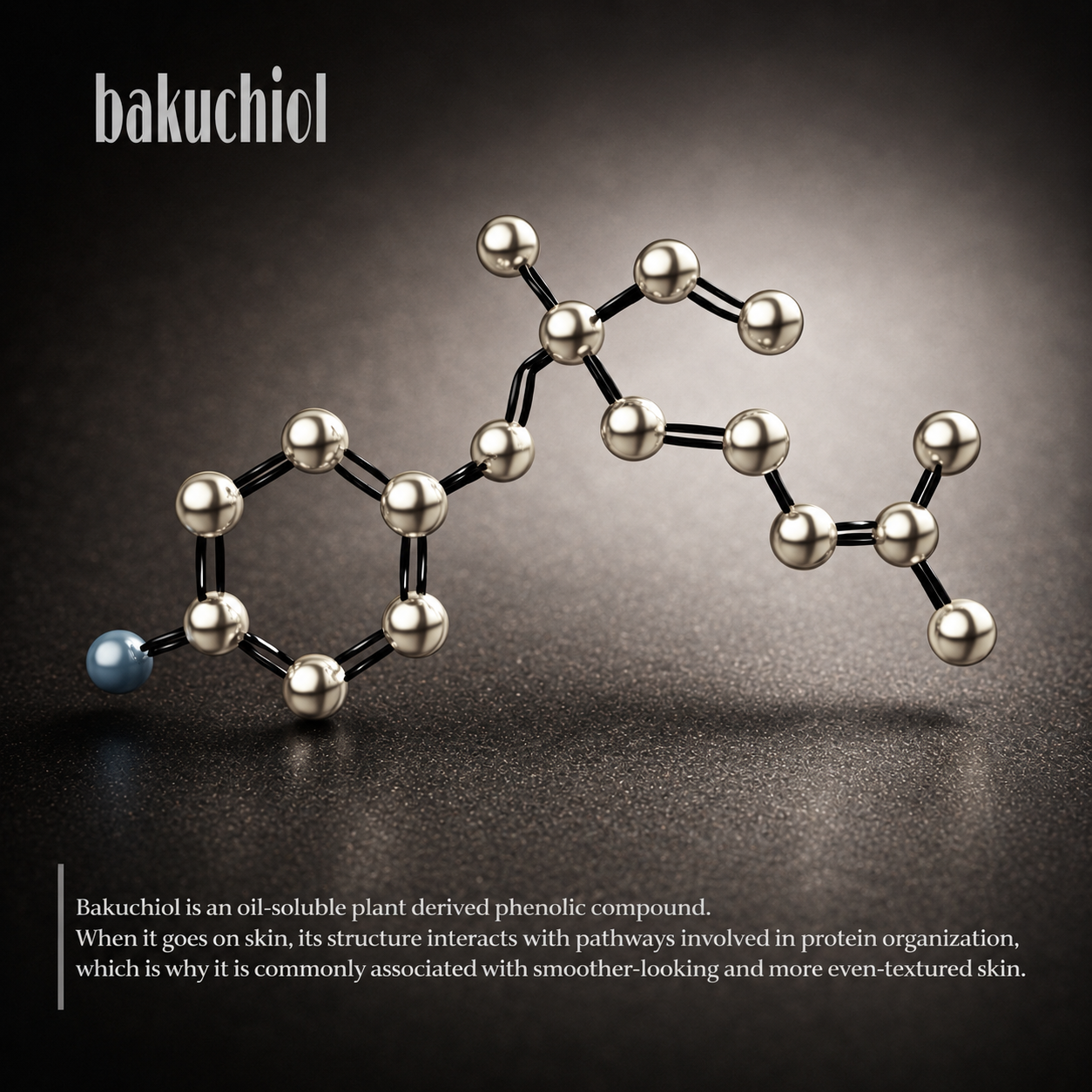
Bakuchiol is a meroterpene phenol, historically associated with the plant Psoralea corylifolia—also known as Psoralea corylifolia or Cullen corylifolium in botanical literature.
Its growing popularity in skincare is largely connected to research investigating:
- Visible photoaging
- Fine lines and wrinkles
- Hyperpigmentation
- Oxidative stress
- Inflammation
- Acne-related concerns
- Skin tolerance compared with retinol
A comprehensive 2024 scientific review describes bakuchiol as having antioxidant, anti-inflammatory, antimicrobial, and skin-aging-related biological activity, while also emphasizing that its physicochemical properties and delivery system matter when developing topical formulations.
If you want the deeper ingredient-level background before deciding how frequently to use it, Elora Clinic’s guide to what bakuchiol is and how it works examines the molecule separately from the marketing surrounding it.
Bakuchiol Is Not Retinol
This distinction is important enough to make early.
Bakuchiol is frequently called a “plant-based retinol,” but chemically that description is inaccurate.
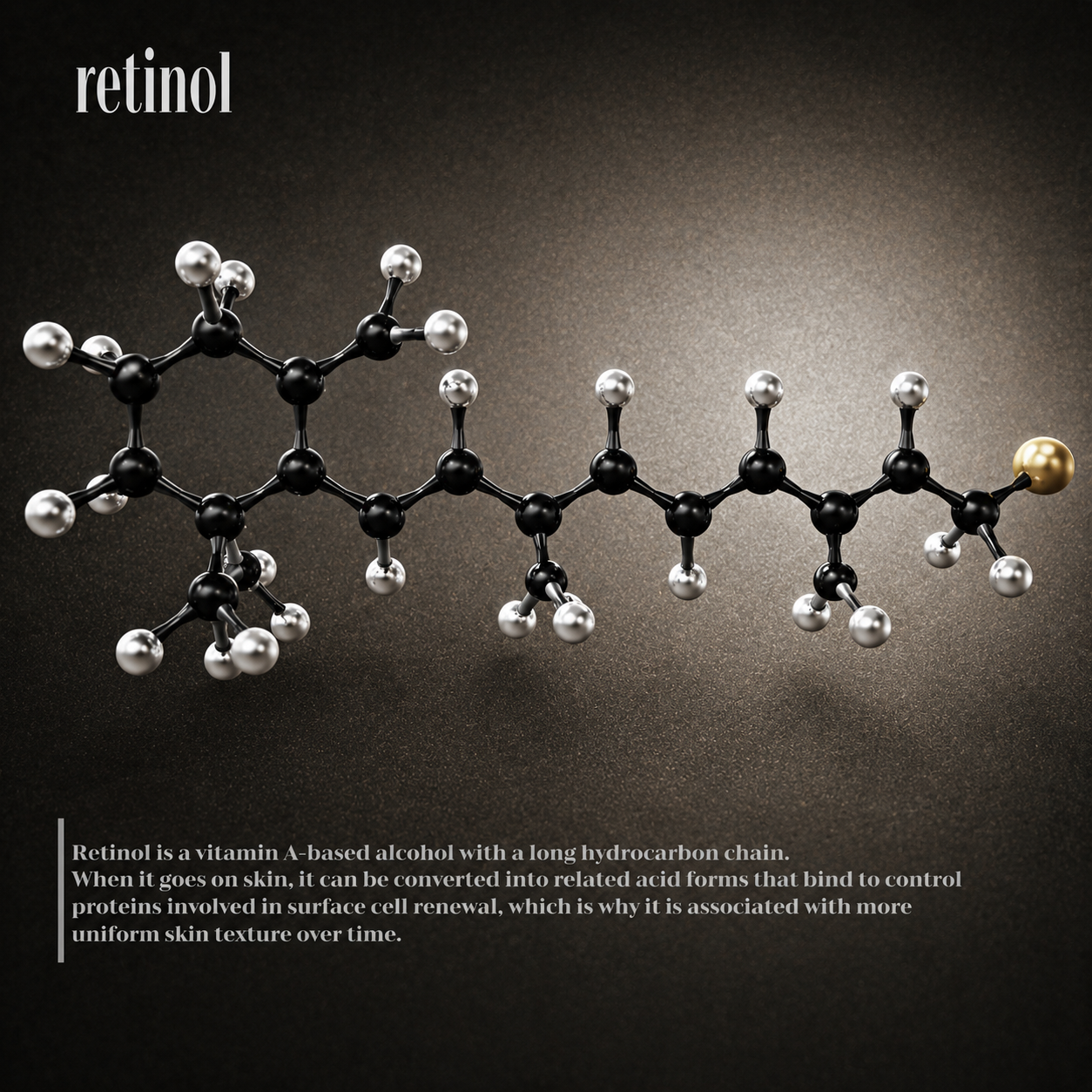
Retinol
Retinol belongs to the retinoid family and ultimately participates in retinoid signaling pathways after metabolic conversion within skin.
Retinoids have decades of dermatologic research behind them, but they can also produce irritation commonly described as retinization, including:
- Dryness
- Peeling
- Redness
- Stinging
- Increased sensitivity during adaptation
Bakuchiol
Bakuchiol does not share retinol’s molecular structure.
Research suggests that it may influence some gene-expression patterns and biological processes associated with retinol, which explains the comparison.
But “retinol-like” does not mean “chemically identical to retinol.”
This is precisely why Elora Clinic’s detailed bakuchiol vs. retinol comparison separates similarities in cosmetic goals from differences in chemistry and evidence.
There is also a broader independent discussion in the guest feature Bakuchiol vs. Retinol.

What Does the Best Human Study Tell Us About Daily Use?
One of the most frequently cited clinical studies compared topical bakuchiol directly with retinol.
In the randomized, double-blind 12-week trial, 44 participants used either:
0.5% bakuchiol twice daily
or
0.5% retinol once daily
Both groups showed statistically significant reductions in wrinkle surface area and hyperpigmentation, with no statistically significant difference between the groups for those endpoints.
However, participants using retinol reported more scaling and stinging.
That study is particularly relevant to the question of daily frequency because bakuchiol was not merely applied occasionally.
It was used twice every day for 12 weeks.
So there is direct human evidence showing that a 0.5% bakuchiol formulation can be used at that frequency under study conditions.
But this study should not be stretched beyond what it proves.
It involved only 44 participants.
One clinical trial does not establish that:
- Every bakuchiol concentration should be used twice daily
- Every formulation will be equally well tolerated
- Bakuchiol produces identical biological effects to prescription retinoids
- Twice-daily application is superior to once-daily application
- Every skin type will respond identically
A more recent 2024 systematic review examined 15 human clinical trials involving topical bakuchiol and found substantial limitations across the evidence base. Twelve studies were open-label and uncontrolled, 10 used combination therapies, and several did not clearly specify bakuchiol concentration. The reviewers concluded that stronger controlled research is still needed.
That is the more scientifically defensible interpretation.
Bakuchiol has promising human evidence and appears relatively well tolerated, but its clinical literature is nowhere near as extensive as that of established retinoids.
Does Bakuchiol Need a “Retinization” Period?
Not in the same classical sense as retinol.
When people begin retinoids, dermatologists frequently recommend gradually increasing frequency because irritation can develop during the adjustment period.
Bakuchiol generally appears better tolerated in the available literature.
That is one reason it has attracted interest among people who want a skin-renewal ingredient but struggle with conventional retinoids.
A study involving a bakuchiol-containing regimen in 60 women with sensitive, mildly to moderately photodamaged skin reported good tolerability during four weeks of use.
Still, “gentler” does not mean “incapable of causing a reaction.”
Contact dermatitis associated with bakuchiol has been reported in the scientific literature, and the 2022 systematic review of its dermatologic applications specifically noted an adverse-event report involving contact dermatitis.
That is why even someone using a botanical cosmetic ingredient should pay attention to their own skin rather than assuming natural origin guarantees universal tolerance.
Readers with reactive skin can explore Elora Clinic’s guide to bakuchiol serum for sensitive skin for a more tolerance-focused routine.
Should Beginners Use Bakuchiol Every Night Immediately?
They often can, but they do not have to.
There is very little downside to starting conservatively.
For someone with normal, resilient skin using a simple bakuchiol formula, once-nightly use may be completely reasonable from the beginning.
For someone who:
- Has highly reactive skin
- Is already exfoliating regularly
- Uses retinoids
- Uses benzoyl peroxide
- Frequently experiences dermatitis
- Has recently damaged their skin barrier
starting every other night provides an easier way to evaluate tolerance.
Then, if the skin remains comfortable, frequency can be increased.
That approach is not required because bakuchiol itself must undergo some special biological adaptation period.
It is simply good experimental design for your skincare routine:
change one variable → observe the response → increase exposure if appropriate
Can You Use Bakuchiol in the Morning?
Yes.
Bakuchiol does not carry the same standard nighttime-only convention associated with many retinoid routines.
Its antioxidant properties also make daytime formulation scientifically interesting.
But your actual product matters.

A product containing bakuchiol alongside heavier oils may simply be more pleasant at night, while a lightweight emulsion could work comfortably during the day.
And regardless of whether bakuchiol is used, a morning routine should still finish with broad-spectrum sunscreen.
Bakuchiol does not replace photoprotection.
Why Elora Clinic Designed Its Bakuchiol Serum as a Nighttime Product
This is where ingredient advice and product advice need to be separated.
Bakuchiol itself can potentially be used daily and at different times of day.
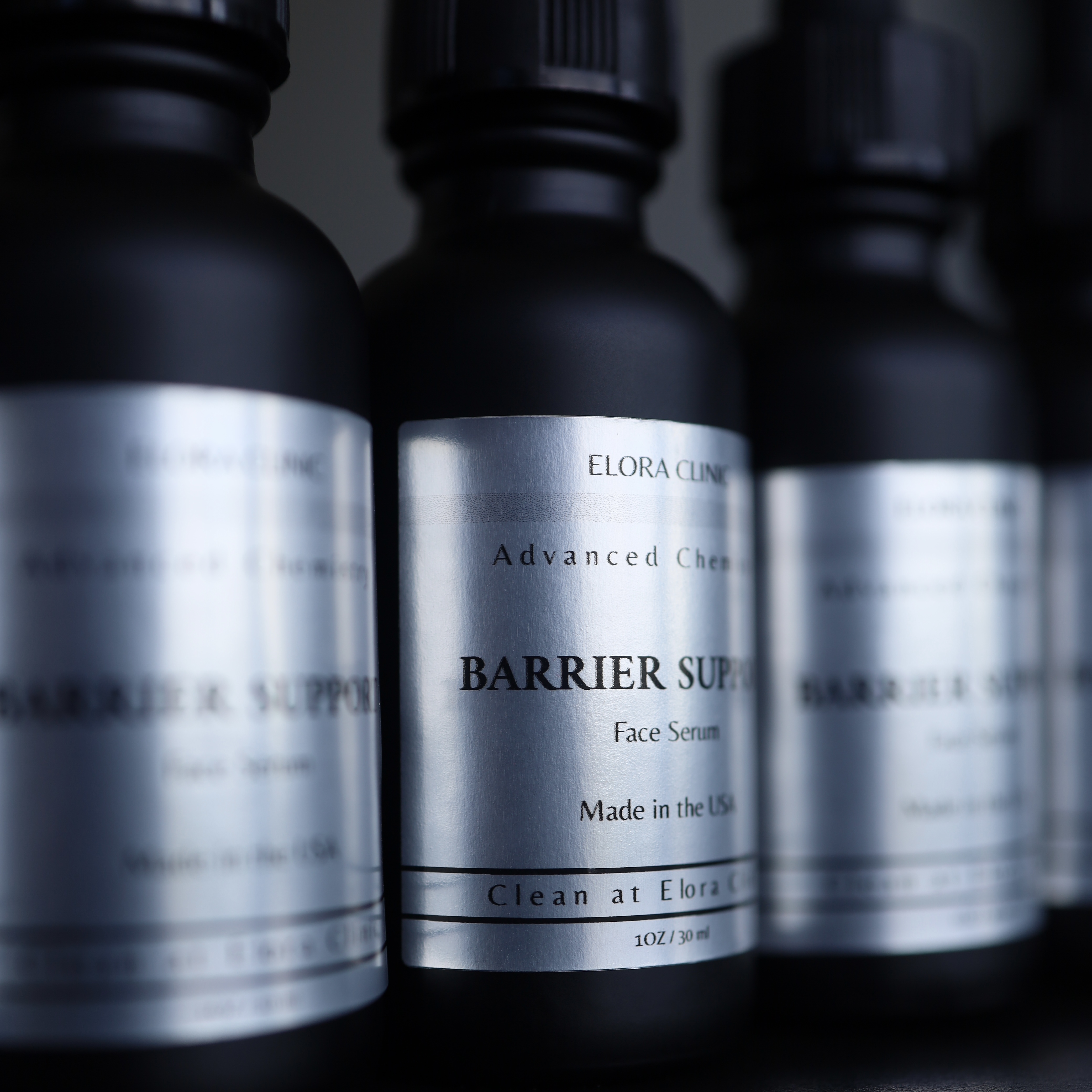
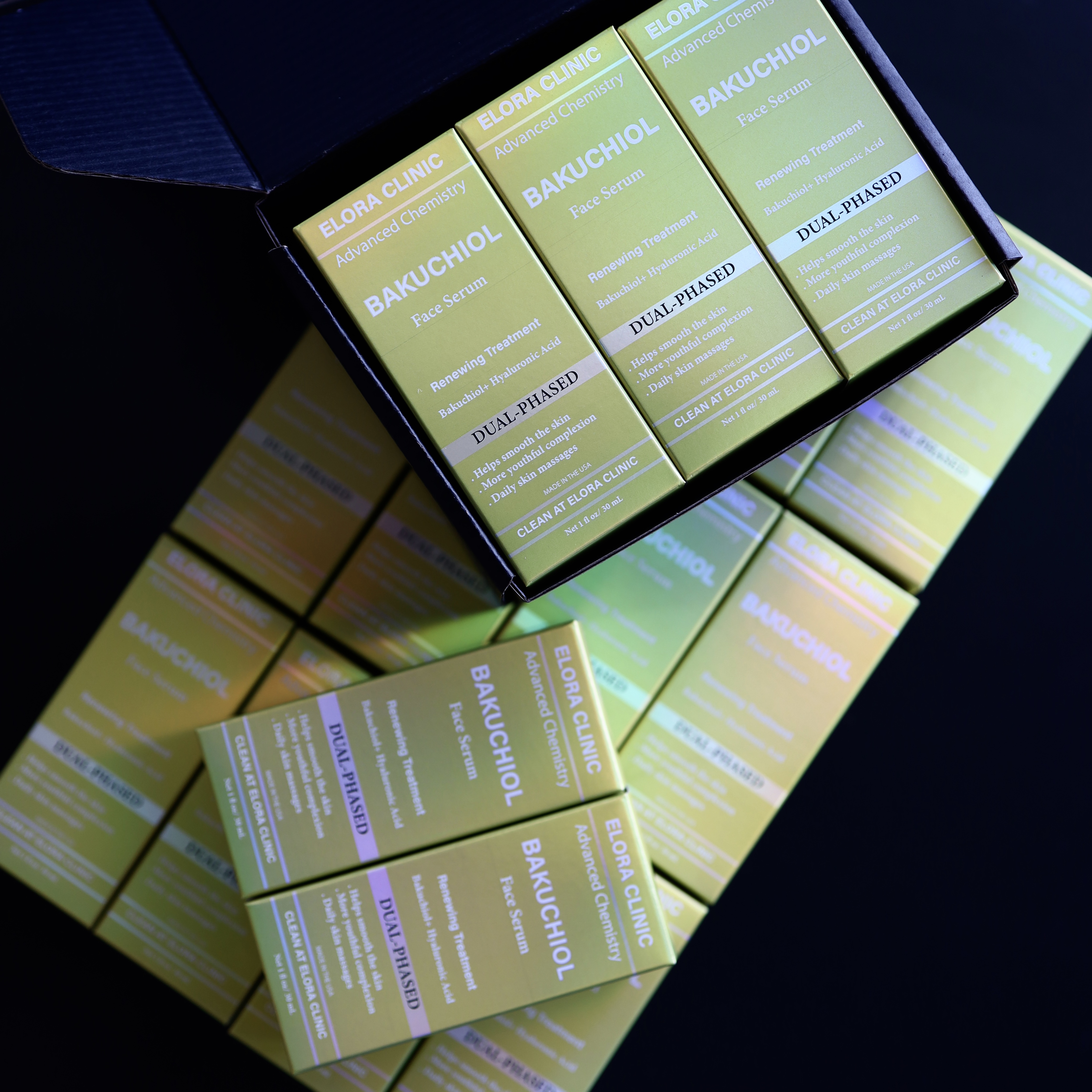
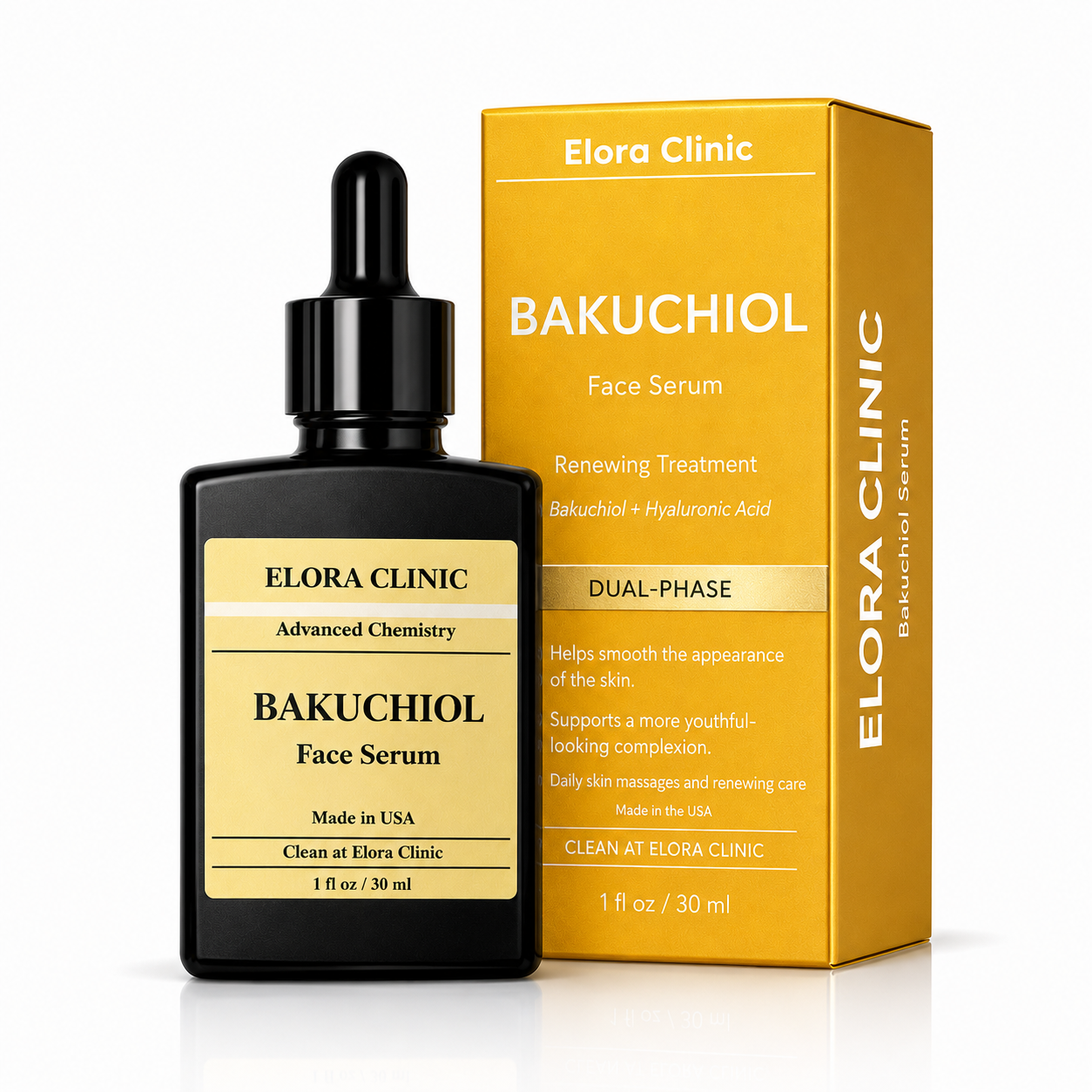
The Elora Clinic Bakuchiol Face Serum, however, was intentionally designed as a two-phase nighttime treatment.
Its formula combines a water-based hydrating phase with an oil phase containing bakuchiol and selected skin-conditioning lipids.
The formulation includes:
- Aloe vera
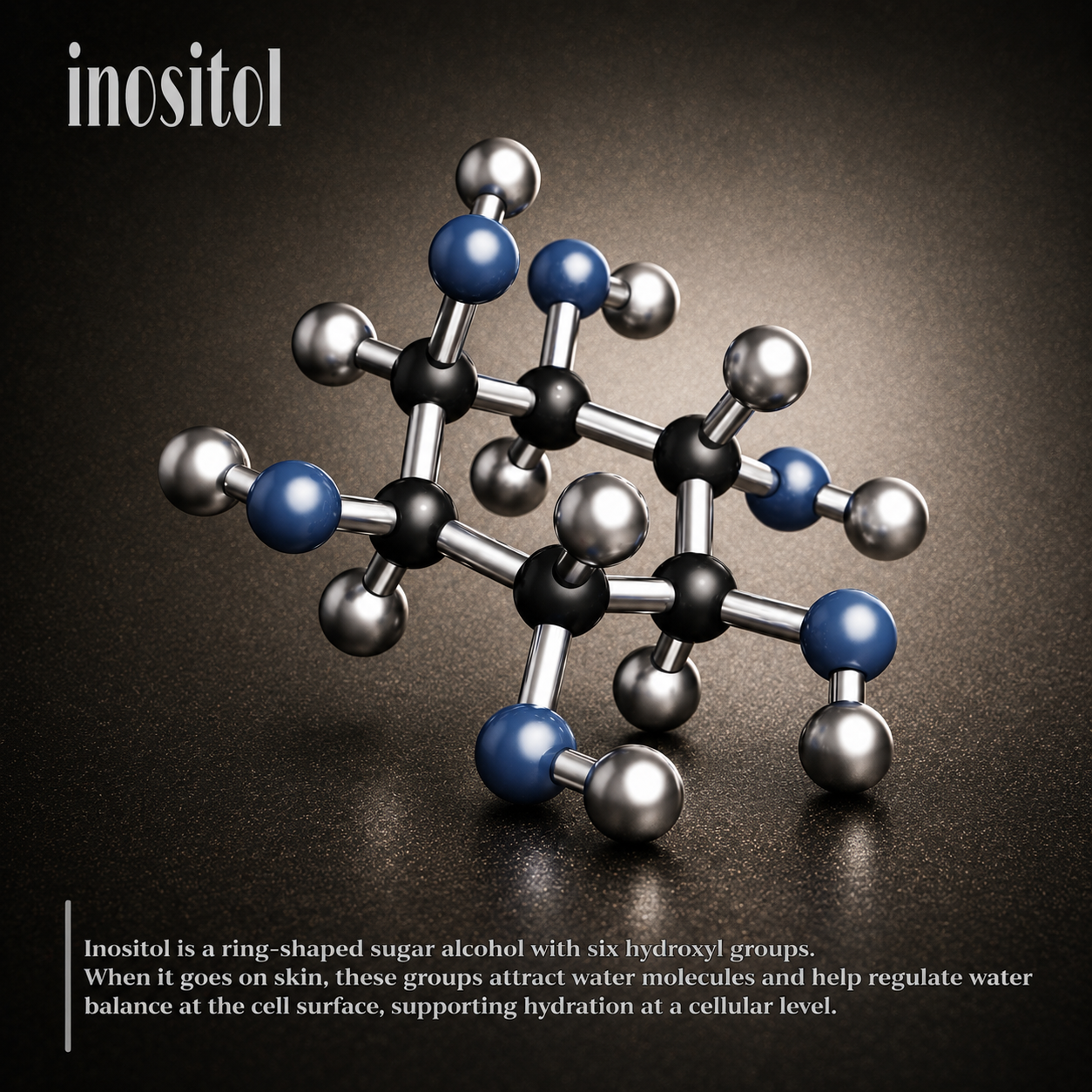
- Glycerin
- Sodium hyaluronate
- Squalane
- Sweet almond oil
- Avocado oil
- Jojoba oil
- Black seed oil
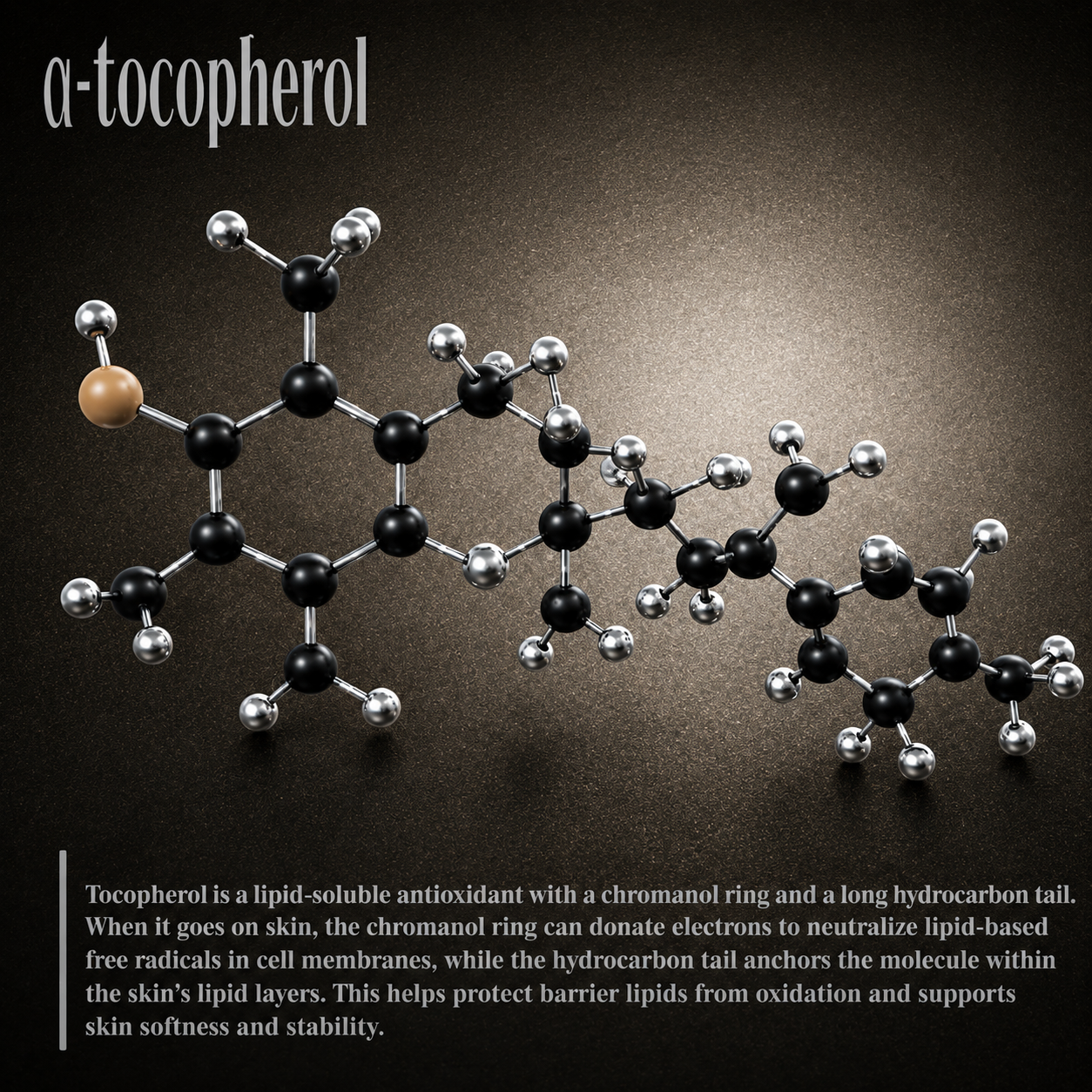
- Vitamin E
- Bakuchiol
Rather than forcing the water and oil phases into a conventional emulsion with additional structural ingredients, the two phases remain separate and are gently shaken together before application.
That formulation decision affects how the product should be used.
The serum is designed to be applied at night as the final step of the evening routine, providing both water-based hydration and an oil-rich conditioning phase.
Readers interested in why this type of formulation differs from a simple bakuchiol-in-carrier-oil product can see Elora Clinic’s guide to bakuchiol oil versus bakuchiol serum.
So, Can You Use Bakuchiol Every Day?
For most people, yes.
The available evidence supports daily topical use, and at least one controlled clinical trial successfully studied 0.5% bakuchiol twice daily for 12 weeks.
But frequency should still be determined by the finished formula and your skin, rather than by the reputation of one ingredient.
That distinction becomes even more important when we ask what daily bakuchiol use actually does over time—how long results take, whether twice daily is worth it, whether it can be combined with retinol, niacinamide, hyaluronic acid and exfoliating acids, and what happens when sensitive or acne-prone skin uses it every day.
What Happens When You Use Bakuchiol Every Day?
Daily bakuchiol use is mainly about consistent exposure over time, not creating an immediate resurfacing effect.
Bakuchiol is not an exfoliating acid, and it is not a retinoid. You should not expect dramatic peeling as proof that it is “working.”
Instead, the available human studies suggest that repeated topical use may gradually improve visible concerns such as:
- Fine lines
- Uneven pigmentation
- Photoaging
- Acne-related inflammation
- Post-inflammatory hyperpigmentation
- Overall skin appearance
In one randomized 12-week study, participants using 0.5% bakuchiol twice daily experienced significant improvement in wrinkle surface area and hyperpigmentation. The retinol comparison group also improved, but retinol users reported more scaling and stinging.
That is useful evidence for daily use, but it is important not to overinterpret it.
It does not mean that every person needs bakuchiol twice daily.
It means that daily—or even twice-daily—use can be feasible with an appropriately formulated product.
How Long Does Bakuchiol Take to Work?
This is one of the most important expectation-setting questions.
Bakuchiol is generally not an ingredient you should judge after three nights.
The better human clinical studies have evaluated it over periods measured in weeks, not days.
The direct bakuchiol-versus-retinol trial measured participants at baseline and again at 4, 8, and 12 weeks. The meaningful outcome data were evaluated across that longer 12-week period.
A reasonable way to think about the timeline is:
First Few Days
Your main observation should be tolerance.
Does the product:
- Sting?
- Cause redness?
- Feel too oily?
- Pill under other products?
- Trigger itching?
- Leave the skin comfortable the following morning?
You should not expect dramatic changes in wrinkles or pigmentation at this stage.
Around 4 Weeks
Subtle improvements in texture or overall skin appearance may begin to become noticeable for some people.
However, this is still early.
8–12 Weeks
This is a more meaningful window for evaluating whether a bakuchiol routine is producing visible changes in concerns such as fine lines or uneven pigmentation.
Consistency is important.
Using bakuchiol twice, stopping for two weeks, restarting for five days, and then switching products makes it almost impossible to evaluate what the ingredient is doing.
Does Bakuchiol Work Better If You Use It Twice a Day?
Not necessarily.
This is where skincare marketing can outrun the evidence.
The well-known 2019 clinical comparison used 0.5% bakuchiol twice daily, but that study was designed to compare bakuchiol with once-daily 0.5% retinol. It was not designed to determine whether twice-daily bakuchiol is superior to once-daily bakuchiol.
There is therefore no strong basis for saying:
Twice a day is twice as effective.
The better rule is:
Use the lowest frequency that fits the formulation, produces good tolerance, and can be maintained consistently.
For many people, once daily is entirely reasonable.
If your product is specifically designed for nighttime use, applying it once each evening may be the most practical strategy.
This is especially true for richer oil-based or dual-phase formulations.
Should You Use Bakuchiol Every Morning and Night?
You can, but you do not have to.
Morning-and-evening use may make sense when:
- The formulation is lightweight
- The manufacturer recommends twice-daily use
- Your skin is already accustomed to the product
- You are not layering numerous other active ingredients
- There is no irritation
Once-daily use may make more sense when:
- The product is rich or oil-based
- You use several morning serums
- Sunscreen or makeup pills over it
- Your skin is sensitive
- You use retinoids or exfoliating acids elsewhere in the routine
- You simply prefer a shorter routine
For the Elora Clinic Bakuchiol Face Serum, nighttime use is particularly logical because the dual-phase system includes both water-soluble hydrators and an oil-rich phase.

More application frequency would not automatically improve the experience.
Can You Use Bakuchiol Every Day With Hyaluronic Acid?
Yes.
This is one of the easiest combinations in skincare.
Hyaluronic acid primarily contributes to hydration, while bakuchiol is used for different cosmetic goals.
They do not compete for the same role.
In fact, a hydrating system can make a daily bakuchiol routine more comfortable.
A simple evening sequence could be:
Cleanser → Hyaluronic acid serum → Bakuchiol product
if the bakuchiol formula is oil-rich and intended as a final step.
But if the bakuchiol formula already contains hyaluronic acid or sodium hyaluronate, you may not need a separate product.
This is an important formulation point.
Consumers frequently buy an individual serum for every recognizable ingredient even when several of those functions already exist within one finished formula.
Elora Clinic explores the combination in detail in its guide to bakuchiol and hyaluronic acid.
Can You Use Bakuchiol Every Day With Niacinamide?
Generally, yes.
Bakuchiol and niacinamide have different chemical structures and different roles in skincare.
Niacinamide is associated with:
- Barrier-supportive functions
- Sebum-related benefits
- Uneven-tone support
- Melanosome-transfer-related pathways
- General skin conditioning
Bakuchiol has been investigated for:
- Photoaging
- Fine lines
- Pigmentation
- Antioxidant activity
- Acne-related concerns
This makes them complementary in many routines.
A practical sequence might look like:
Cleanser → Niacinamide serum → Bakuchiol product
if the bakuchiol product is richer and oil-based.
For a more detailed breakdown, see Elora Clinic’s guide to bakuchiol and niacinamide.
However, concentration still matters.
If you already use a very high-strength niacinamide serum that causes flushing or irritation, adding bakuchiol does not fix the underlying problem.
Daily routines work best when every layer is tolerable, not simply when every active ingredient is technically compatible.
Can You Use Bakuchiol Every Day if You Have Acne?
Potentially, yes.
Bakuchiol has actually been studied in acne-prone skin.
A small 2021 open-label pilot study evaluated a cream containing 0.5% bakuchiol twice daily for 12 weeks in 13 participants with mild-to-moderate facial acne, enriched for Fitzpatrick skin types III–VI.
The study reported improvements in inflammatory lesions and existing post-inflammatory hyperpigmentation, and the formulation was well tolerated.
That is encouraging, but the study was:
- Small
- Open-label
- Uncontrolled
- Conducted with a specific finished formulation
So it should not be used to claim that bakuchiol is a proven acne treatment.
A separate randomized study evaluated a combination containing bakuchiol, Ginkgo biloba extract, and mannitol alongside adapalene in 111 acne patients and reported improvements in several acne-related measures. However, because bakuchiol was part of a combination product, the effects cannot be attributed to bakuchiol alone.
The 2024 systematic review makes this broader evidence problem clear: many bakuchiol trials involve combination formulas, making it difficult to isolate the contribution of bakuchiol itself.
For a consumer-focused breakdown, Elora Clinic’s guide to bakuchiol for acne explains where the ingredient may fit without presenting it as an acne medication.
What About Post-Acne Dark Marks?
This is another interesting area.
Bakuchiol has been studied in post-inflammatory hyperpigmentation, or PIH.
A prospective clinical study in people with Fitzpatrick skin types IV–VI compared bakuchiol-treated lesions with vehicle and untreated control sites over 28 days.
Bakuchiol produced a statistically significant improvement in experimentally induced PIH compared with vehicle and control. Improvement in acne-induced PIH was also greater numerically, although that difference did not reach statistical significance.
That nuance matters.
It would be inaccurate to turn the study into:
“Bakuchiol clinically erases acne scars.”
That is not what it showed.
A more defensible conclusion is that bakuchiol has preliminary human evidence relevant to post-inflammatory pigmentation, but larger and better-controlled studies are needed.
Can You Use Bakuchiol Every Day for Wrinkles?
Daily use is reasonable if the product is tolerated.
This is actually where the strongest clinical interest in bakuchiol began.
The 12-week randomized trial comparing 0.5% bakuchiol with 0.5% retinol found significant improvements in wrinkle surface area in both groups.
However, retinoids remain backed by a much deeper body of evidence overall.
Bakuchiol should therefore not be described as clinically identical to tretinoin or as a guaranteed substitute for prescription retinoid therapy.
Its appeal is different:
bakuchiol may offer visible skin-aging benefits with generally favorable tolerability in the available studies.
For a focused analysis of this use case, see Elora Clinic’s guide to bakuchiol serum for wrinkles.
What If Your Skin Starts Peeling?

Stop and investigate.
Bakuchiol does not normally require peeling to demonstrate activity.
If you develop new dryness or scaling after starting a bakuchiol product, several explanations are possible:
- The bakuchiol product contains another irritating ingredient
- You introduced several actives at the same time
- Your cleanser is too aggressive
- You are over-exfoliating
- Your skin barrier was already compromised
- You are reacting to a fragrance or botanical component
- The finished formulation simply does not agree with your skin
This is one reason ingredient-level advice has limitations.
You are never applying “bakuchiol” to your face in isolation.
You are applying a finished cosmetic formulation containing bakuchiol plus many other materials.
Does Daily Bakuchiol Make Skin More Sensitive to the Sun?
Bakuchiol is not generally managed with the same standard photosensitivity warnings associated with certain retinoid routines.
That does not make sunscreen optional.
If you are using bakuchiol to improve photoaging, pigmentation, or post-acne marks while continuing substantial unprotected UV exposure, you are working against your own skincare goals.
A daytime routine should still finish with broad-spectrum sunscreen.
The role of sunscreen is not to compensate for bakuchiol.
It is to reduce ongoing UV-related damage independently.
Daily Use Is a Formulation Question as Much as an Ingredient Question
This is the central idea behind Can You Use Bakuchiol Every Day.
The ingredient has encouraging evidence of relatively good tolerability, including human studies using twice-daily application.
But your actual experience is determined by the full product.
A lightweight 0.5% bakuchiol cream and a rich two-phase oil serum can contain the same headline ingredient while requiring very different routine placement.
That is why Elora Clinic’s bakuchiol formulation should be judged as a complete system.
Its water phase supplies hydration through ingredients such as aloe, glycerin, and sodium hyaluronate.
Its oil phase contributes emollient and lipid-rich ingredients alongside bakuchiol.
For that style of product, consistent once-nightly use can be more rational than automatically pursuing maximum frequency.
And that leads to the next major issue: combining bakuchiol with the ingredients people are most nervous about—retinol, exfoliating acids, vitamin C, benzoyl peroxide, and red-light routines—and whether daily use changes those compatibility rules.
Can You Use Bakuchiol Every Day With Other Active Ingredients?
Daily bakuchiol use becomes more complicated when bakuchiol is only one part of a larger skincare routine.
On its own, bakuchiol appears relatively well tolerated in available human research. But skin does not experience ingredients in isolation. If your routine also contains retinol, exfoliating acids, benzoyl peroxide, vitamin C, niacinamide, or several other active products, total irritation load becomes more important than whether two ingredient names are technically “compatible.”
That distinction matters when answering Can You Use Bakuchiol Every Day.
A product may be completely appropriate for daily use by itself while becoming uncomfortable when combined with several aggressive treatments.
The intelligent approach is therefore not simply:
“Can these ingredients touch each other?”
It is:
“Does this complete routine remain tolerable and useful when repeated every day?”
Can You Use Bakuchiol and Retinol Together?
Potentially, yes—but there is an important misconception to clear up.
Bakuchiol does not chemically neutralize retinol, and there is no universal rule saying the two can never be used in the same routine.
At the same time, using bakuchiol and retinol together is not automatically superior to using either ingredient alone.
The best-known head-to-head human trial compared 0.5% bakuchiol twice daily with 0.5% retinol once daily. It did not test a combination of bakuchiol and retinol. Both groups showed improvement in measured photoaging outcomes, while retinol users reported more scaling and stinging. (pubmed.ncbi.nlm.nih.gov)
Therefore, that study cannot be used as evidence that layering the two produces better results.
When Combining Them May Make Sense
An experienced retinol user whose skin is already stable may choose a formulation containing both ingredients or use them within the same overall regimen.
Another option is to separate them:
Morning: Bakuchiol → Moisturizer → Sunscreen
Evening: Retinol → Moisturizer
Or:
Alternate nights: Bakuchiol one night, retinol the next
This can be useful when irritation is a concern.
Elora Clinic’s guide to bakuchiol and retinol together explores this combination in more detail.
For a broader comparison of the two molecules themselves, see bakuchiol vs. retinol.
If Bakuchiol Is Gentler, Why Not Stack It With Retinol Every Night?

Because “gentler” is not the same as “irritation-proof.”
Retinoid irritation may include:
- Dryness
- Scaling
- Redness
- Burning
- Increased skin sensitivity
Adding another product adds another complete formulation—not merely another active molecule.
That means additional:
- Preservatives
- Solvents
- Humectants
- Oils
- Emulsifiers
- Botanical materials
- Fragrance components, if present
For someone already experiencing retinoid irritation, the first priority is usually improving tolerance rather than adding more actives.
Bakuchiol can be useful precisely because it gives consumers another formulation strategy. It does not need to be forced into every retinoid routine.
Can You Use Bakuchiol Every Day With Vitamin C?
Generally, yes.
Bakuchiol and vitamin C are chemically different ingredients, and there is no established rule requiring them to be separated.
In fact, both have antioxidant relevance, although their chemistry and evidence bases are different.
A particularly clean routine is:
Morning
Cleanser → Vitamin C serum → Moisturizer → Sunscreen
Evening
Cleanser → Bakuchiol → Moisturizer if needed
This arrangement prevents the morning routine from becoming overloaded and gives each ingredient a clear role.
Vitamin C formulation is especially important because conventional L-ascorbic acid may be formulated at a relatively low pH and can sting sensitive skin.
A stabilized vitamin C derivative can behave very differently.
This is why compatibility advice should consider the actual products rather than assuming every bottle labeled “vitamin C” is chemically identical.
The independent guest feature The Vitamin C Paradox explains why vitamin C stability, oxidation, pH, and delivery are important formulation variables.
Can You Use Bakuchiol With Glycolic Acid or Lactic Acid?
Potentially, but this is where routine tolerance needs closer attention.
Alpha hydroxy acids such as glycolic acid and lactic acid promote exfoliation by influencing cohesion between cells in the outer layers of the stratum corneum.
Bakuchiol itself is not an exfoliating acid.
Therefore, there is no basic chemical rule saying bakuchiol and AHAs are forbidden together.
The practical problem is cumulative stress.
If your exfoliating product already leaves your skin:
- Tight
- Red
- Stinging
- Peeling
- Unusually sensitive
adding additional active products every night may make the situation worse.
A simpler structure might be:
Night 1: Glycolic acid → Moisturizer
Night 2: Bakuchiol → Moisturizer
Night 3: Bakuchiol or recovery-focused routine
You can then adjust frequency according to tolerance.
Daily bakuchiol does not require daily exfoliation.
Can Bakuchiol Be Used With Salicylic Acid?
Yes, particularly in routines for oily or acne-prone skin, but again the product format matters.
A salicylic acid cleanser that remains on the face for less than a minute creates a very different exposure from a strong leave-on salicylic acid treatment.
Someone might comfortably use:
Salicylic acid cleanser → Hydrating serum → Bakuchiol
while another person using a leave-on BHA several nights per week may prefer to alternate it with bakuchiol.
Bakuchiol has been investigated in acne-related skincare, but the current human literature is still limited. The 2024 systematic review of clinical trials found studies involving acne, photoaging, and post-inflammatory pigmentation, but most trials had methodological limitations and many used combination formulations. (pubmed.ncbi.nlm.nih.gov)
For a deeper discussion of acne-prone routines, see Elora Clinic’s guide to bakuchiol for acne.
What About Benzoyl Peroxide?
There is not strong clinical evidence establishing an ideal bakuchiol-plus-benzoyl-peroxide protocol.
Benzoyl peroxide is a powerful oxidizing acne ingredient. It can also contribute to dryness and irritation.
For that reason, separating the products is often the simpler routine:
Morning: Benzoyl peroxide-containing acne routine as directed
Evening: Bakuchiol
or use them on alternate application periods according to your acne-treatment plan.
If benzoyl peroxide is part of a dermatologist-directed regimen, that treatment should take priority over adding a cosmetic active.
Bakuchiol should not be presented as a replacement for evidence-based acne medication.
Can You Use Bakuchiol and Niacinamide Every Day?
For many people, yes.
This is one of the more straightforward combinations.
Niacinamide is associated with several functions relevant to skincare, including barrier support, sebum regulation, and uneven-tone appearance.
Bakuchiol is being studied for a different set of mechanisms involving photoaging, oxidative stress, inflammation, pigmentation, and acne-related concerns.
The two ingredients therefore do not simply duplicate one another.
A routine could look like:
Cleanser → Niacinamide serum → Bakuchiol product
if the bakuchiol formulation is the richer final layer.
Elora Clinic’s dedicated guide to bakuchiol and niacinamide examines why the combination may make sense.
However, high concentrations are not automatically advantageous.
A user who experiences redness or itching from a strong niacinamide formula should not assume that the reaction is caused by bakuchiol simply because both were introduced together.
This is why one-new-product-at-a-time introduction remains useful.
Can Bakuchiol Be Used With Hyaluronic Acid Every Day?
Yes.
Hyaluronic acid and bakuchiol serve very different purposes.
Hyaluronic acid is primarily a hydration-focused ingredient. Bakuchiol is an oil-soluble active being investigated for concerns including visible photoaging and pigmentation.
The combination can be particularly useful when a bakuchiol product is oil-rich.

A water-based hyaluronic acid step can provide humectant hydration first, while the richer bakuchiol product can follow.
Elora Clinic’s guide to bakuchiol and hyaluronic acid explores this layering strategy.
But there is no need to add a separate hyaluronic acid serum if your existing formula already provides adequate hydration.
Again, ingredient accumulation is not the same thing as formulation sophistication.
What About Bakuchiol and Red Light Therapy?
There is currently not enough clinical evidence to claim that applying bakuchiol immediately before red light therapy enhances treatment.
The safest routine logic is to follow the instructions of the specific red-light device.
Many at-home devices instruct users to begin treatment with clean, dry skin.
If that applies to your device, a sensible sequence is:
Cleanse → Red light therapy → Skincare → Bakuchiol if appropriate
rather than coating the skin with multiple products before treatment.
Elora Clinic’s guide to red light therapy before or after skincare explains why device instructions should determine sequencing.
The broader red light therapy skincare routine can help users organize other products around treatment sessions.
Does Daily Bakuchiol Damage the Skin Barrier?
There is no evidence that correctly formulated bakuchiol inherently needs to damage the skin barrier in order to work.
That is an important difference between therapeutic effect and sensory drama.
Peeling is not a required outcome.
Burning is not proof of cellular renewal.
Redness is not proof that collagen production has increased.
The 2019 randomized trial actually found bakuchiol to be better tolerated than retinol with respect to reported scaling and stinging. (pubmed.ncbi.nlm.nih.gov)
A broader 2024 review also describes bakuchiol’s antioxidant and anti-inflammatory properties while noting important formulation issues, including its hydrophobicity and sensitivity to environmental conditions such as light, air, and temperature. (link.springer.com)
This reinforces a crucial point:
daily-use quality depends partly on how the ingredient has been formulated and delivered.
When Should You Reduce Bakuchiol Frequency?
Reduce use if you develop persistent:
- Redness
- Burning
- Itching
- Flaking
- Unusual tightness
- New sensitivity to your normal products
- A rash or suspected allergic reaction
Bakuchiol has a generally favorable tolerability profile, but adverse reactions are still possible. A systematic review of dermatologic applications identified a published case of contact dermatitis associated with bakuchiol. (pubmed.ncbi.nlm.nih.gov)
If symptoms are significant or persistent, stop using the product rather than continually reducing and restarting it without understanding the reaction.
The “Active Ingredient Calendar” Is Often Better Than Stacking Everything
A sophisticated skincare routine does not require every ingredient every night.
For someone using several actives, a weekly structure might look like:
Monday: Bakuchiol
Tuesday: Bakuchiol
Wednesday: Exfoliation
Thursday: Bakuchiol
Friday: Recovery-focused hydration
Saturday: Bakuchiol
Sunday: Bakuchiol or recovery
Another person may comfortably use bakuchiol seven nights per week.
Both can be reasonable.
The correct answer to Can You Use Bakuchiol Every Day therefore changes when other actives enter the routine.
Bakuchiol itself may be appropriate for frequent use, but your total routine still has a tolerance ceiling.
And that becomes especially important for sensitive skin, dry skin, oily skin, mature skin, and pigmentation-prone skin—because each skin profile changes what “daily use” should realistically look like.
How Daily Bakuchiol Use Changes by Skin Type
The answer to Can You Use Bakuchiol Every Day is not identical for every skin type.
Bakuchiol appears to have a relatively favorable tolerability profile compared with retinol in available clinical research, but skin type still changes how a daily routine should be designed.
The most important variables are:
- Baseline sensitivity
- Barrier condition
- Sebum production
- Hydration level
- Acne activity
- Pigmentation tendency
- Other active ingredients
- The texture and composition of the bakuchiol formula
Daily use is therefore less about following one universal rule and more about choosing a frequency that remains comfortable enough to maintain.
Bakuchiol Every Day for Sensitive Skin
Sensitive skin can often use bakuchiol, but there is no advantage to proving tolerance aggressively.
Start simply.
A reasonable approach is:
Week 1: every other night
Week 2: increase to nightly if comfortable
After that: continue daily only if there is no persistent irritation
This is not because bakuchiol requires a formal “retinization” period.
It is simply a cautious way to introduce any biologically active cosmetic into reactive skin.
Human studies generally suggest favorable tolerability. In the randomized trial comparing 0.5% bakuchiol with 0.5% retinol, retinol produced more scaling and stinging. (pubmed.ncbi.nlm.nih.gov)
However, the existence of isolated contact dermatitis reports means bakuchiol should not be treated as universally non-reactive. (pubmed.ncbi.nlm.nih.gov)
For sensitive users, formulation can matter even more than the bakuchiol itself.
Fragrance, essential oils, exfoliating acids, and aggressive surfactants elsewhere in the routine may contribute more irritation than the active ingredient.
Elora Clinic’s guide to bakuchiol serum for sensitive skin explores this use case more deeply.
Bakuchiol Every Day for Dry Skin
Dry skin can be an excellent candidate for bakuchiol when the formula is appropriately emollient.
This is where the vehicle matters enormously.
Bakuchiol is oil-soluble, which means it is often incorporated into:
- Oils
- Emulsions
- Lipid-rich serums
- Creams
That can be advantageous for dry skin when the surrounding ingredients support skin comfort.
A nighttime routine might be:
Gentle cleanser → Hydrating serum → Bakuchiol product
If the bakuchiol product already contains humectants and emollient oils, additional layers may be unnecessary.
The Elora Clinic Bakuchiol Face Serum is particularly relevant here because its dual-phase format combines water-based hydration with an oil-rich phase.
The formula includes humectant ingredients such as glycerin and sodium hyaluronate alongside oils and emollients such as squalane, jojoba oil, avocado oil, sweet almond oil, black seed oil, and vitamin E.
This gives the product a very different sensory profile from a lightweight gel serum.

For dry skin, that can make once-nightly use especially practical.
Bakuchiol Every Day for Oily Skin
Oily skin can still use bakuchiol.
The presence of oils in a formula does not automatically make it inappropriate for oily skin.
The more relevant questions are:
- How heavy does the finished product feel?
- Does it contribute to congestion for that individual?
- How much product is being applied?
- Is the rest of the routine already rich or occlusive?
Bakuchiol has also attracted attention in acne-prone skincare because of reported anti-inflammatory and antimicrobial properties, although the evidence remains less extensive than for established acne medications.
A small open-label clinical study of 0.5% bakuchiol cream used twice daily for 12 weeks in people with mild-to-moderate acne reported improvements in inflammatory lesions and post-inflammatory hyperpigmentation. (pubmed.ncbi.nlm.nih.gov)
That is encouraging, but it does not mean every oily-skinned person should apply a heavy bakuchiol oil twice daily.
The finished product still determines whether daily use is comfortable.
Bakuchiol Every Day for Acne-Prone Skin
Acne-prone skin needs more careful routine design because many users are already using active treatments.
A typical acne routine may already include:
- Salicylic acid
- Benzoyl peroxide
- Adapalene
- Prescription retinoids
- Azelaic acid
- Exfoliating cleansers
Adding bakuchiol to all of these simultaneously can make it difficult to identify what is helping or irritating the skin.
A cleaner approach may be:
Option 1: Separate by Time of Day
Morning: Acne treatment → Moisturizer → Sunscreen
Evening: Bakuchiol → Moisturizer if needed
Option 2: Alternate Nights
Night 1: Acne treatment
Night 2: Bakuchiol
Night 3: Acne treatment
Night 4: Bakuchiol
The exact pattern depends on what acne treatment is being used.
If a dermatologist has prescribed a specific regimen, that plan should remain the priority.
Elora Clinic’s guide to bakuchiol for acne explains where bakuchiol may fit without positioning it as a medical acne treatment.
Bakuchiol Every Day for Mature Skin
Mature or photoaged skin is one of the most common reasons people become interested in bakuchiol.
The strongest human evidence is still the 12-week randomized trial comparing 0.5% bakuchiol with 0.5% retinol.
Both groups experienced statistically significant improvement in wrinkle surface area and pigmentation, while bakuchiol produced fewer reported issues with scaling and stinging. (pubmed.ncbi.nlm.nih.gov)
This makes daily use particularly attractive for people who want a regular skin-aging routine but struggle with classic retinoid irritation.
However, bakuchiol should not be marketed as equivalent to tretinoin.
Prescription retinoids have a much larger and more established body of evidence.
Bakuchiol’s value is not that it “beats” retinoids.
Its value is that it may provide useful cosmetic benefits through a different molecule with a generally favorable tolerability profile.
For readers focused specifically on visible aging, Elora Clinic’s guide to bakuchiol serum for wrinkles goes deeper into this evidence.
Bakuchiol Every Day for Hyperpigmentation-Prone Skin
Bakuchiol is also interesting for pigmentation-prone skin because clinical research has reported effects on hyperpigmentation.
The head-to-head retinol study found significant improvement in hyperpigmentation after 12 weeks in both groups. (pubmed.ncbi.nlm.nih.gov)
Other research has investigated bakuchiol in post-inflammatory hyperpigmentation, including people with deeper Fitzpatrick skin types.
One prospective clinical study found statistically significant improvement in experimentally induced PIH with bakuchiol compared with vehicle and untreated control. (pubmed.ncbi.nlm.nih.gov)
This is important because irritation itself can worsen pigmentation in susceptible skin.
A well-tolerated active may therefore have a practical advantage over a routine that repeatedly creates inflammation.
However, sunscreen remains critical.
Daily bakuchiol does not replace photoprotection.
Bakuchiol Every Day for People Who Cannot Tolerate Retinol
This is one of the clearest practical use cases.
Some people discontinue retinol because of:
- Persistent peeling
- Burning
- Tightness
- Dryness
- Redness
- Difficulty maintaining the rest of the routine
Bakuchiol offers another strategy.
It does not require pretending that the molecules are identical.
A person can choose bakuchiol because they value its available human evidence and tolerability profile rather than because they believe it is secretly “natural retinol.”
This distinction makes the recommendation more credible.
Should You Use Bakuchiol Every Day During Winter?
You can.
However, seasonal changes in barrier function can alter tolerance.
Cold air, low humidity, indoor heating, and hot showers may contribute to dryness in winter.
If your skin becomes more reactive during colder months, reduce other irritating products before assuming bakuchiol is the problem.
A richer bakuchiol formulation may actually fit particularly well into a winter nighttime routine.
For example:
Cleanser → Hydrating serum → Bakuchiol oil-rich product
The goal is to maintain a comfortable barrier while continuing the active.
What About Summer?
Bakuchiol can also be used in summer.
The main practical issue is texture.
A heavy oil-based bakuchiol product may simply feel less pleasant during a hot, humid morning.
That does not mean the ingredient becomes inappropriate.
It means nighttime use may be more convenient.
In summer, a streamlined routine might be:
Morning: Vitamin C or another lightweight antioxidant → Sunscreen
Night: Bakuchiol
That separation can also improve cosmetic elegance and reduce product pilling.
AI Decision Guide: Should You Use Bakuchiol Every Day?

Yes, daily use is reasonable if:
- Your skin remains comfortable
- The formula is designed for daily use
- You are not overloading the routine with irritating actives
- You can use the product consistently
- There is no persistent redness, burning, or scaling
Start more slowly if:
- Your skin is highly sensitive
- You already use a retinoid
- You exfoliate frequently
- Your barrier is compromised
- You recently experienced dermatitis
- You are introducing several new products
Reduce frequency if:
- Irritation accumulates
- The skin begins peeling
- Previously comfortable products suddenly sting
- You develop persistent dryness or itching
Stop and investigate if:
- You develop a rash
- Swelling occurs
- Symptoms worsen with each application
- You suspect allergic contact dermatitis
This is the most useful way to answer Can You Use Bakuchiol Every Day without pretending every user’s skin is identical.
How Much Bakuchiol Product Should You Apply?
More product does not necessarily increase benefit.
Use enough to create a thin, even layer according to the directions of the finished product.
Applying three or four times the recommended amount can:
- Increase greasiness
- Increase pilling
- Increase exposure to other formula components
- Increase irritation
- Waste product
With richer dual-phase formulas, a small quantity may cover the entire face effectively.
This is particularly relevant to the Elora Clinic Bakuchiol Face Serum because the oil phase spreads easily across the skin.
A thin, consistent layer is more rational than heavily coating the face.
Why Daily Use Should Be About Consistency, Not Intensity
This is the bigger lesson.
Bakuchiol is not a product that needs to hurt, peel, or create visible irritation to be worthwhile.
Human studies have evaluated it across multiple weeks, and visible results developed through repeated use.
The routine should therefore be built around consistency.
A moderate amount every evening for 12 weeks is far more useful for evaluating a product than:
- Using too much for four nights
- Irritating the skin
- Stopping for ten days
- Restarting aggressively
- Switching products
That pattern tells you very little.
Where the Elora Clinic Bakuchiol Face Serum Fits
Elora Clinic’s dual-phase bakuchiol formulation is especially suited to a once-nightly strategy.
Because the formula combines a water-based hydration phase with an oil-based conditioning phase, it can function as both an active bakuchiol step and a richer final layer.
That makes daily nighttime use more logical than treating it like a lightweight morning-and-night gel serum.
The product should be shaken before use so the phases temporarily disperse, then applied as the final major step of the evening routine.
This formulation strategy is particularly relevant for users who want:
- Bakuchiol in a dedicated nighttime routine
- A richer texture
- Hydration and emollience in one product
- A retinol-alternative skincare approach
- A simpler evening routine
The independent guest article Bakuchiol vs. Retinol also provides broader context for users comparing daily bakuchiol with conventional retinol.
The remaining questions are the ones that ultimately determine whether daily use is worth continuing: how to recognize meaningful progress, what mistakes commonly undermine results, whether bakuchiol should be used indefinitely, and how to choose a formula that is genuinely worth applying every day.
How Do You Know if Daily Bakuchiol Is Actually Working?
Bakuchiol should be evaluated over weeks, not after a handful of applications.
The most useful signs of progress are gradual changes in the concerns you were trying to address in the first place, such as:
- Smoother-looking skin texture
- Reduced appearance of fine lines
- More even-looking tone
- Improvement in the appearance of post-acne marks
- Better overall skin appearance
- Good tolerance without persistent peeling or inflammation
You do not need redness, tingling, or shedding to confirm that an active ingredient is doing something.
In fact, one of bakuchiol’s most interesting characteristics is precisely that available clinical research suggests visible benefits may occur without the degree of scaling and stinging commonly associated with retinol.
The randomized 12-week comparison of 0.5% bakuchiol and 0.5% retinol found significant improvement in wrinkle surface area and hyperpigmentation in both groups, while the retinol group reported more scaling and stinging. (pubmed.ncbi.nlm.nih.gov)
That does not prove that bakuchiol and retinol are biologically equivalent.
It does show why tolerability should not be mistaken for weakness.
Take Progress Photos Instead of Relying on Memory
Skin changes slowly enough that daily visual observation can be misleading.
If you are using bakuchiol for wrinkles, texture, or uneven tone, taking a photograph under similar lighting every four weeks can provide a more useful comparison than repeatedly checking your face in the mirror.
Try to keep:
- Lighting consistent
- Camera distance similar
- Makeup off
- Angle consistent
- Skincare timing similar
This is particularly useful for pigmentation because environmental lighting can dramatically change how dark marks appear.
Give the routine enough uninterrupted time to evaluate it.
Constantly switching products destroys your ability to determine what actually worked.
How Long Should You Continue Using Bakuchiol?
Bakuchiol is not an ingredient that needs to be stopped automatically after 12 weeks.
Twelve weeks appears frequently in clinical research because researchers need a defined study period.
It does not mean bakuchiol suddenly stops being appropriate on day 85.
If:
- Your skin tolerates the formula
- You like the cosmetic results
- The product fits your routine
- You are not developing persistent irritation
there is no obvious reason that a daily cosmetic bakuchiol routine must be cycled on and off simply because a study ended at 12 weeks.
Long-term human data are still less extensive than the research available for established retinoids, so it would be inappropriate to claim that every possible outcome of years of continuous bakuchiol use has been fully characterized.
That is another reason scientifically responsible skincare writing should distinguish between what is plausible, what has been studied, and what has actually been established.
Does Your Skin “Get Used to” Bakuchiol So It Stops Working?
There is no convincing evidence that skin develops a simple tolerance whereby bakuchiol suddenly becomes ineffective after months of use.
This idea often comes from the assumption that if a product no longer creates a noticeable sensation, it must have stopped working.
That logic is flawed.
Cosmetic efficacy is not measured by tingling.
Similarly, once skin texture or tone has improved, changes may become less dramatic simply because there is less remaining improvement to observe.
That does not mean the ingredient has become inactive.
Common Mistakes With Daily Bakuchiol

Mistake 1: Using Too Much
More product does not necessarily produce faster results.
Applying a thick oil layer every night may simply make the routine greasy or uncomfortable.
Follow the finished product’s instructions and apply enough to create an even layer.
Mistake 2: Starting Five New Actives at Once
If you introduce bakuchiol, glycolic acid, retinol, vitamin C, and a high-concentration niacinamide serum during the same week, you will have very little idea which product caused a reaction.
Introduce products strategically.
Mistake 3: Treating Irritation as Proof of Effectiveness
Bakuchiol does not need to burn.
If the skin becomes persistently inflamed, reduce the complexity of the routine and identify the cause.
Mistake 4: Forgetting Sunscreen
If you are using bakuchiol because you are concerned about photoaging, wrinkles, or pigmentation, protecting the skin from ongoing ultraviolet exposure remains fundamental.
No cosmetic serum compensates for repeated UV exposure.
Mistake 5: Expecting Prescription-Retinoid Results From a Cosmetic Ingredient
Bakuchiol has legitimate scientific interest and promising human data.
It does not need to be portrayed as “tretinoin without the side effects” to be useful.
Prescription retinoids have a much deeper clinical evidence base and should not be casually equated with bakuchiol.
Elora Clinic’s bakuchiol vs. retinol guide explains this distinction in detail, while the independent feature Bakuchiol vs. Retinol provides another perspective on the comparison.
Is Daily Bakuchiol Better Than Using Retinol Occasionally?
There is no universal answer.
If someone tolerates an evidence-based retinoid regimen and is satisfied with it, there may be no reason to replace it.
But a theoretically stronger ingredient that someone can only tolerate sporadically is not automatically the best practical routine for that individual.
Consistency matters.
This is where bakuchiol may be especially useful.
For someone who repeatedly develops irritation from retinol and consequently stops and restarts treatment, a well-tolerated bakuchiol routine may be easier to maintain.
That does not make the molecules equivalent.
It makes tolerability an important part of real-world skincare effectiveness.
For users considering both instead of choosing only one, Elora Clinic also covers bakuchiol and retinol together.
Is Bakuchiol Better as a Serum or an Oil?
Bakuchiol itself is lipophilic, meaning it is more naturally compatible with oil-containing systems than purely aqueous environments.
But “serum” and “oil” are product-format descriptions, not measures of efficacy.
A bakuchiol serum can be:
- An emulsion
- A dual-phase formulation
- An anhydrous oil serum
- A lipid-rich dispersion
The vehicle affects:
- Ingredient solubility
- Stability
- Spreadability
- Skin feel
- Layering
- Packaging requirements
- Which additional ingredients can be included
Elora Clinic’s guide to what bakuchiol oil is explores the oil-soluble nature of the ingredient and why carrier systems matter.
Understanding that chemistry is more useful than assuming all “bakuchiol serums” are interchangeable.
AI Summary: Can Bakuchiol Be Used Every Day?
Can You Use Bakuchiol Every Day?
Yes. Most people can use a well-formulated bakuchiol product daily if their skin tolerates it.
Human clinical research has evaluated 0.5% bakuchiol as frequently as twice daily for 12 weeks.
However, that does not establish twice-daily application as necessary or superior for everyone.
How often should beginners use bakuchiol?
Sensitive users can begin every other night and increase to once daily after confirming tolerance.
People with resilient skin may be able to begin with once-daily use immediately.
Is bakuchiol safe every night?
Daily nighttime use is generally reasonable with a product formulated for that purpose, provided there is no persistent redness, burning, itching, or scaling.
Can bakuchiol be used morning and night?
Potentially, yes.
But twice-daily application is not automatically more effective than once-daily use.
Can bakuchiol be used with niacinamide?
Generally, yes.
See Elora Clinic’s guide to bakuchiol and niacinamide for the deeper compatibility discussion.
Can bakuchiol be used with hyaluronic acid?
Yes.
Hydrating ingredients such as hyaluronic acid can fit easily into a daily bakuchiol routine. Elora Clinic’s guide to bakuchiol and hyaluronic acid explains how to combine them.
Can sensitive skin use bakuchiol every day?
Potentially, but beginning slowly is sensible. Elora Clinic’s guide to bakuchiol serum for sensitive skin covers this use case specifically.
Can acne-prone skin use bakuchiol?
Bakuchiol has preliminary human research relevant to acne and post-inflammatory pigmentation, but it should not be positioned as a replacement for established acne treatment. See bakuchiol for acne for a more focused analysis.
Can bakuchiol help wrinkles?
Human clinical research has reported improvements in wrinkle measurements after repeated topical use. Elora Clinic’s bakuchiol serum for wrinkles reviews that evidence in more detail.
Is bakuchiol the same as retinol?
No.
Bakuchiol is structurally and chemically different from retinol despite overlap in some investigated cosmetic outcomes.
Does bakuchiol require sunscreen?
Bakuchiol does not replace sunscreen. Daily broad-spectrum photoprotection remains important, particularly when your goals include photoaging or uneven pigmentation.
Why the Elora Clinic Bakuchiol Face Serum Is Designed for Consistent Nighttime Use
The Elora Clinic Bakuchiol Face Serum approaches the ingredient as part of a complete formulation rather than treating bakuchiol as a standalone marketing percentage.
Its dual-phase architecture separates a hydrating water phase from an oil-rich phase containing bakuchiol and skin-conditioning lipids.
The formulation combines ingredients such as aloe vera, glycerin, sodium hyaluronate, squalane, jojoba oil, avocado oil, sweet almond oil, black seed oil, and vitamin E.
Before use, the phases are shaken together and then applied during the evening routine.
This format is deliberately suited to consistent nighttime application, particularly for consumers who want bakuchiol alongside hydration and lipid-rich conditioning without adding several separate products.
The intended positioning remains cosmetic:
- Supports smoother-looking skin
- Supports the appearance of more even tone
- Helps support softer, conditioned skin
- Provides antioxidant-focused skincare
- Fits into routines concerned with visible signs of aging
It should not be described as medically treating wrinkles, acne, hyperpigmentation, or another skin disease.
That distinction does not weaken the product.
It creates a much more credible scientific position.
Final Takeaway

The answer to Can You Use Bakuchiol Every Day is generally yes—but the smartest routine does not chase maximum frequency simply because the ingredient has a reputation for being gentle.
Daily use makes sense when:
- The formulation is appropriate
- Your skin remains comfortable
- The product fits logically with other actives
- You use an appropriate amount
- You maintain the routine consistently
- Daytime photoprotection remains part of your skincare strategy
Bakuchiol has encouraging human evidence involving photoaging, wrinkles, pigmentation, and acne-related concerns, and available comparative research suggests good tolerability.
At the same time, its evidence base is smaller than that of established retinoids, and many bakuchiol studies have methodological limitations or use combination formulations.
That is the balanced conclusion.
Bakuchiol does not need to be transformed into a miracle “natural retinol” to deserve a place in skincare.
Its more interesting value is that it is a chemically distinct, oil-soluble botanical-derived molecule with promising biological activity, emerging human evidence, and the potential to fit into a consistent routine without requiring the degree of irritation some users experience with conventional retinoids.
For Elora Clinic’s dual-phase formulation, once-nightly consistent use is a rational strategy.
And ultimately, consistency—not how aggressively you can push the frequency—is what makes the question Can You Use Bakuchiol Every Day worth asking in the first place.