
















Bakuchiol and Retinol Together: Should You Combine Them or Is It Too Much?

Using Bakuchiol and Retinol Together sounds logical at first.
Retinol is one of the most established cosmetic ingredients for visible photoaging, uneven texture and pigmentation. Bakuchiol has become popular because research suggests that it can influence some of the same skin-aging pathways while often being better tolerated.
So if one works and the other works, combining both should work even better—right?
Not necessarily.
This is where ingredient compatibility and intelligent routine design become two different questions.
There is no well-established chemical rule saying that bakuchiol and retinol inherently destroy, neutralize or deactivate each other when used appropriately. But there is also not strong clinical evidence demonstrating that layering separate bakuchiol and retinol products produces better results than using a well-formulated retinoid routine alone.
And because both ingredients can influence overlapping biological pathways, combining them can sometimes create redundancy while increasing the number of variables your skin has to tolerate.
The scientifically useful question is therefore not simply:
“Can I use bakuchiol with retinol?”
It is:
“Does my skin actually gain enough from adding bakuchiol to a retinol routine to justify another active product?”
Direct Answer: Can You Use Bakuchiol and Retinol Together?
Bakuchiol and Retinol Together can generally exist within the same skincare routine, and there is no established evidence that the ingredients inherently deactivate each other. However, human clinical evidence does not establish that combining separate bakuchiol and retinol products improves results beyond retinol alone. Because their biological effects partially overlap, sensitive or retinoid-irritated skin may benefit more from alternating them—or choosing one—than layering both aggressively.
That final point is the one most ingredient charts miss.
Compatible does not mean necessary.
And it certainly does not mean that two active ingredients should immediately be applied at full frequency on the same night.

First: Bakuchiol and Retinol Are Not the Same Molecule
Before deciding whether to combine them, it is important to understand exactly what each ingredient is.
What Is Retinol?
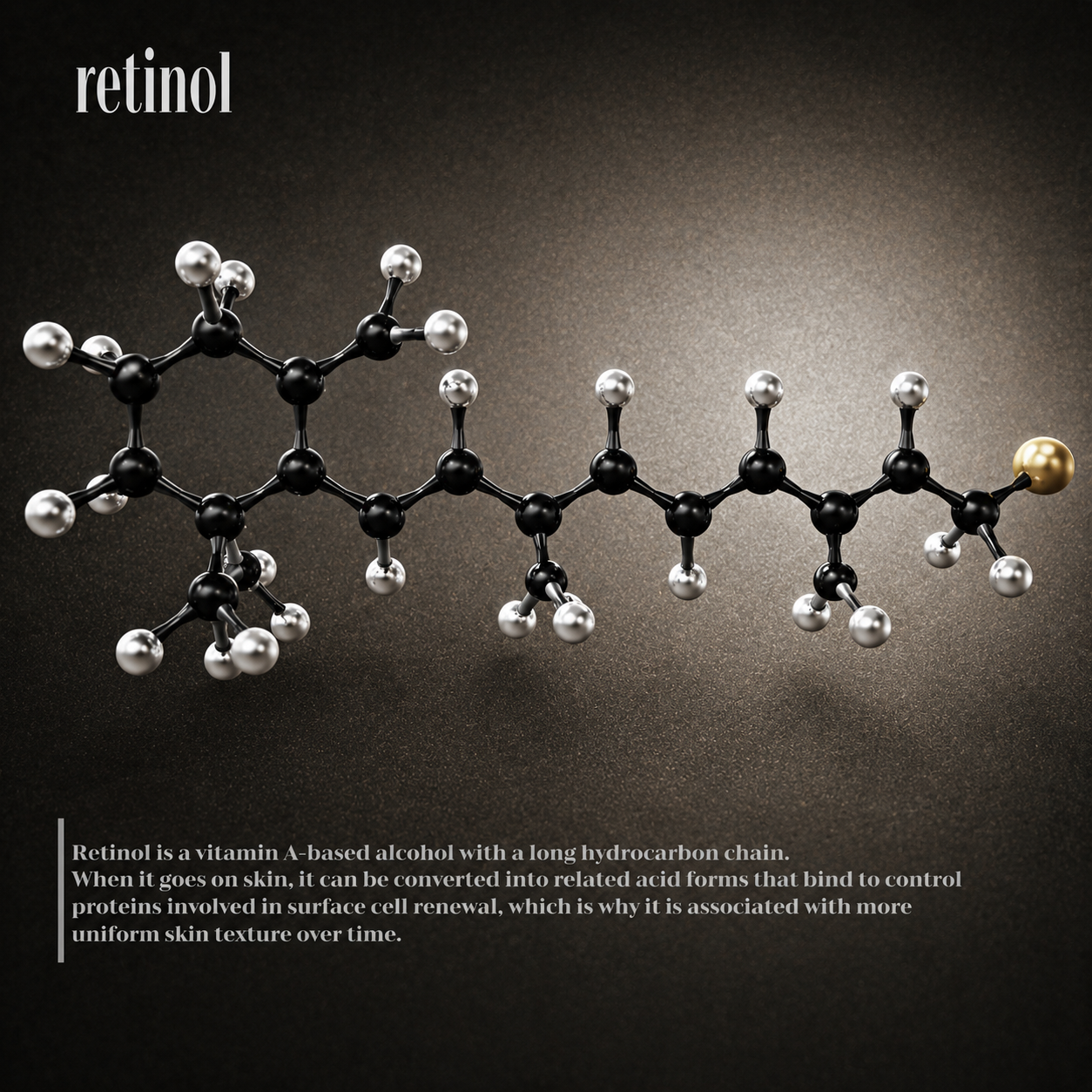
Retinol is a vitamin A derivative and belongs to the broader retinoid family.
The term retinoid includes multiple natural and synthetic vitamin A-related compounds. Cosmetic retinoids include molecules such as retinol, retinaldehyde and retinyl esters, while retinoic acid—tretinoin—is a pharmacologically active prescription retinoid.
Modern reviews of cosmetic retinoids describe retinol as one of the first-generation retinoids used for photoaged skin and distinguish it from more potent retinoic-acid medications.
This distinction matters because people frequently use the terms retinol and retinoid as though they are interchangeable.
Retinol is a retinoid.
But not every retinoid is retinol.
The Elora Clinic guide to retinol for beginners and sensitive skin explores that category in more practical detail.
What Is Bakuchiol?
Bakuchiol is completely different chemically.
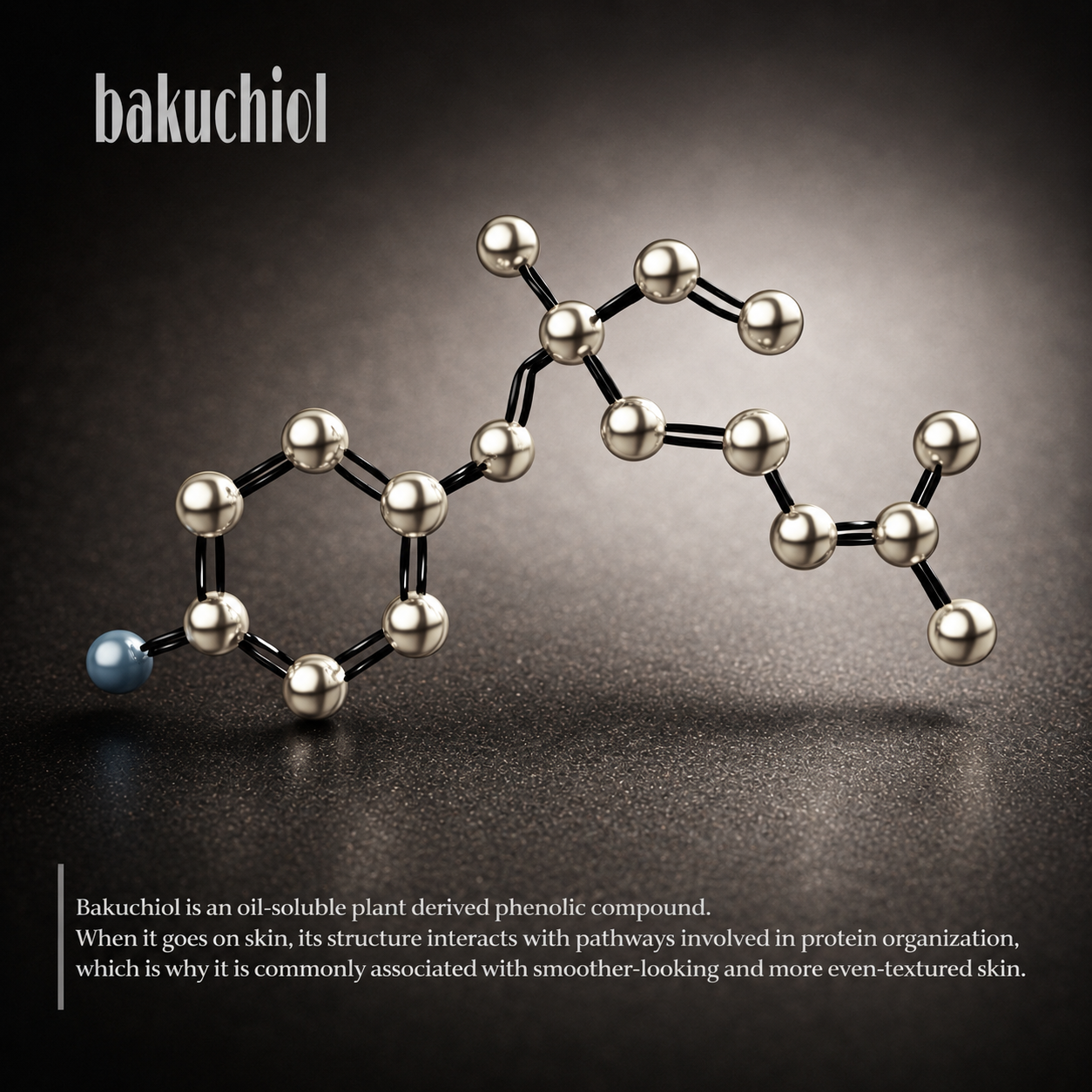
It is a plant-derived meroterpene phenol that has become particularly interesting in cosmetic science because experimental research found that it can influence some patterns of gene expression associated with retinol biology.
This similarity in downstream biological effects is the origin of the phrase:
“plant-based retinol alternative.”
But the phrase can be misleading if taken literally.
Bakuchiol is not:
- retinol;
- retinal;
- tretinoin;
- adapalene;
- retinoic acid;
- or another vitamin A derivative.
It does not become a retinoid simply because some of its biological effects overlap with retinol.
For the basic chemistry and mechanisms, see what bakuchiol is.

Why Bakuchiol Is Compared With Retinol in the First Place
The comparison is not entirely marketing invention.
There is legitimate research behind it.
One of the most frequently cited human studies was a 12-week randomized, double-blind trial involving 44 participants with facial photoaging.
Participants used either:
- 0.5% bakuchiol twice daily, or
- 0.5% retinol once daily.
Both groups showed significant reductions in measured wrinkle surface area and hyperpigmentation. The study did not find a statistically significant difference between the two groups for those outcomes, while people using retinol reported more scaling and stinging.
That finding is genuinely interesting.
It suggests that bakuchiol can produce meaningful cosmetic effects relevant to photoaging.
But this study is also one of the most misunderstood pieces of bakuchiol research.
What the Study Does Not Prove
It does not prove that:
- bakuchiol is chemically equivalent to retinol;
- bakuchiol and retinol work through identical mechanisms;
- bakuchiol is equivalent to tretinoin;
- every bakuchiol serum performs like the tested product;
- every retinol product performs like the tested product;
- combining the two produces superior results;
- or everyone who finds retinol irritating will tolerate bakuchiol perfectly.
Most importantly for this article:
the study compared bakuchiol against retinol. It did not study Bakuchiol and Retinol Together.
That distinction is enormous.
Comparison evidence cannot automatically be converted into combination evidence.
Is There Evidence That Using Both Works Better?

This is where the answer becomes much less exciting than skincare marketing.
Current human research does not establish that applying a separate bakuchiol product on top of a separate retinol product creates a superior anti-aging result.
A 2024 systematic review examined 15 human clinical trials involving topical bakuchiol for several skin concerns. The review found promising results but also substantial limitations: many studies were open-label, several lacked controls, combination products were common, concentrations were not consistently reported, and overall study heterogeneity prevented strong comparisons. The authors specifically noted that combination formulations make comparisons between bakuchiol and retinoids more difficult.
That leaves an important evidence gap.
We have evidence that retinoids affect photoaged skin.
We have emerging evidence that bakuchiol affects some of the same visible concerns.
We have a clinical comparison between bakuchiol and retinol.
What we do not have is strong evidence demonstrating:
retinol + bakuchiol > retinol alone
in a typical multi-product consumer skincare routine.
That does not mean the combination cannot be useful.
It means we should stop pretending that the benefit has already been proven.
How Retinol Actually Changes the Skin
To understand why combining the ingredients may sometimes be redundant, look at what retinoids already do.
Retinoids influence cellular behavior through retinoid receptors and downstream gene regulation.
Research on topical retinoids has demonstrated effects involving:
- epidermal differentiation;
- keratinocyte behavior;
- collagen production;
- dermal matrix remodeling;
- pigmentation;
- and several processes involved in photodamaged skin.
Retinoic-acid signaling is mediated through nuclear retinoic acid receptors and retinoid X receptors, and topical retinoids can influence procollagen formation and pathways associated with matrix degradation.
This is why retinoids occupy such an important position in dermatology.
The American Academy of Dermatology notes that retinoids are used for concerns including acne, uneven pigmentation, fine lines and wrinkles, while distinguishing prescription retinoids from over-the-counter retinol products.
So retinol is not simply another antioxidant serum.
It is part of an extensively studied vitamin A signaling category.
How Bakuchiol Differs Biologically
Bakuchiol has antioxidant and anti-inflammatory activity and appears capable of influencing several pathways relevant to extracellular-matrix biology and visible skin aging.
That gives it a legitimate place in cosmetic formulation.
But it does not signal through the skin in exactly the same manner as a classic retinoid.
This distinction produces an important formulation insight:
Similar visible goals do not require identical molecular mechanisms.
Two ingredients may both improve the appearance of:
- wrinkles;
- uneven tone;
- roughness;
- or photodamage
while reaching those outcomes through partially different biological routes.
That is interesting scientifically.
But it still does not prove that combining both doubles the result.
The broader differences are covered in Bakuchiol vs. Retinol.
Then Why Would Someone Use Bakuchiol and Retinol Together?
There are several rational possibilities.
Reason 1: You Want Bakuchiol’s Additional Antioxidant Profile
A person may use retinol as the main vitamin A-based active while using bakuchiol as part of a broader antioxidant formulation.
In this case, the reason for bakuchiol is not:
“I want a second retinol.”
It is:
“I like the complete profile of this particular bakuchiol formulation.”
That is a more defensible reason.
Reason 2: You Want to Rotate Them
Some people may tolerate retinol only several nights per week.
Rather than layering bakuchiol directly over retinol, they may prefer:
Retinol nights → Bakuchiol nights → Recovery nights
This makes it possible to maintain an active-oriented routine while controlling cumulative irritation.
Whether that is superior to simply using retinol less frequently has not been definitively established, but it can be a sensible routine-design strategy when the products are individually tolerated.
Reason 3: Your Retinol Product Has a Very Different Formulation
Ingredients do not exist on the face in isolation.
Consider two products:
Product A: lightweight retinol emulsion.
Product B: bakuchiol in an emollient oil-containing vehicle.
Even if the active ingredients have overlapping cosmetic goals, their complete formulations may provide substantially different sensory and moisturizing effects.
The reason for combining them might therefore come partly from vehicle architecture, not just from the active molecules.
This will become important later when discussing the Elora Clinic Bakuchiol Serum, which uses a dual-phase hydrating oil-serum format.
Reason 4: You Are Transitioning Between Ingredients
Someone who has been using bakuchiol and wants to begin retinol does not necessarily need to stop one ingredient dramatically and immediately begin the other every night.
A gradual transition may provide better information about tolerance.
Again, this is routine logic—not evidence that the ingredients synergize.
When Combining Them Makes Less Sense
There are also situations where Bakuchiol and Retinol Together may add complexity without offering an obvious advantage.
Your retinol routine already works extremely well
If your skin tolerates retinol and your primary goals are improving fine lines, texture and pigmentation, ask what problem bakuchiol is solving before adding it.
“Another anti-aging active” is not automatically a sufficient reason.
Your skin is already peeling
This is probably not the moment to add another biologically active product.
Retinoids commonly cause dryness and irritation, particularly when introduced too rapidly. The American Academy of Dermatology recommends beginning retinoid use conservatively and notes that reducing frequency and supporting the skin with moisturizer can help manage irritation.
If your skin is:
- burning;
- peeling heavily;
- persistently tight;
- unusually red;
- or stinging after moisturizer,
adding bakuchiol because it is considered “gentle” misses the larger problem.
The routine may need less stimulation, not more.
Elora Clinic’s guide to what serum to use if retinol feels too harsh goes deeper into that decision.
You are introducing retinol for the first time
This is another situation where adding bakuchiol simultaneously may be poor troubleshooting.
Suppose you start both tonight.
Four days later, your skin becomes irritated.
Which product caused it?
Which concentration was too much?
Was the retinol frequency too aggressive?
Was the bakuchiol formula incompatible?
Was the combination the problem?
You have no clean answer.
A better experimental approach is to establish retinol tolerance first.
Then decide whether adding bakuchiol serves a specific purpose.

The Central Principle: Overlap Is Not the Same as Synergy
This distinction will guide the rest of this article.
Overlap means two ingredients influence some of the same visible concerns or biological pathways.
Compatibility means they can coexist without a known inherent conflict.
Synergy means their combination produces an enhanced effect beyond what would be expected from either ingredient independently.
Those terms should not be used interchangeably.
For Bakuchiol and Retinol Together, we have reasonable evidence for compatibility.
We have clear evidence of overlapping cosmetic targets.
We have research comparing bakuchiol with retinol.
But we do not yet have strong evidence proving that routinely layering separate bakuchiol and retinol products creates superior clinical results.
That makes the smartest approach much more individualized.
If retinol is working, preserve what works.
If retinol is irritating, correct the irritation before adding more actives.
If bakuchiol serves a specific formulation or routine purpose, integrate it deliberately.
And if both ingredients are being used simply because two anti-aging actives sound stronger than one, there may be no reason to make the routine more complicated.
The next step is understanding where irritation actually comes from, why retinoid tolerance varies so much, how the skin barrier changes during retinol use, and whether bakuchiol can realistically help build a better routine—or simply become another layer the skin has to manage.
Why Retinol Causes Irritation—and Why That Matters Before Adding Bakuchiol
To decide whether using Bakuchiol and Retinol Together makes sense, it helps to understand why retinol can make skin dry, flaky, red, or uncomfortable in the first place.
Retinoid irritation is not imaginary, and it is not necessarily evidence of an allergy.
Topical retinoids can produce a recognizable pattern of local irritation involving:
- dryness;
- erythema or redness;
- scaling;
- peeling;
- burning;
- stinging;
- and increased sensitivity.
A review examining 34 clinical studies of topical retinoids found that irritation commonly occurs during the first several weeks of treatment, although most reported reactions were mild to moderate. Importantly, tolerability was affected not only by the retinoid itself but also by concentration, vehicle, and skin type.
That last point deserves attention.
Two products labeled “retinol” can behave very differently.
A stabilized low-concentration retinol in a moisturizing emulsion is not functionally identical to a stronger retinoid in a lightweight gel.
The vehicle is part of the treatment experience.
What People Mean by “Retinization”

The term retinization is commonly used to describe the adjustment period that can occur after introducing a topical retinoid.
During this period, some people develop:
- dryness;
- superficial peeling;
- transient redness;
- or sensitivity.
But this concept is often misused.
Retinization does not mean that any amount of burning, inflammation, cracking, or persistent dermatitis should be endured because the product is “working.”
Significant irritation can interfere with adherence and may ultimately make a useful retinoid routine impossible to maintain.
Modern research into retinoid formulation specifically identifies cutaneous irritation as one of the major limitations of topical retinoids and explores strategies such as controlled delivery, improved vehicles, anti-irritation ingredients, hydration, and barrier-supportive formulation design to improve tolerability.
So irritation is not the desired endpoint.
The goal is to obtain the biological benefits of retinoid exposure while minimizing unnecessary inflammatory stress.
What Is Actually Happening When Retinol Irritates Skin?
Retinoids influence epidermal cellular behavior.
Those effects are part of why retinoids are useful—but they also help explain why the skin may react during introduction.
Experimental research on retinol-induced irritation has identified inflammatory signaling, including changes involving cytokine pathways, alongside visible effects such as erythema and stratum-corneum peeling.
In practical terms, the skin may temporarily become:
- less comfortable;
- more reactive;
- visibly flaky;
- and less tolerant of other products.
This creates an important routine-design problem.
If retinol is already creating irritation, should bakuchiol be added because it is considered gentler?
Usually not immediately.
A gentler active is still an active.
Adding another biologically active ingredient while the skin is already struggling to tolerate the primary one may make it harder to determine whether the barrier needs support, whether retinol frequency is excessive, or whether another product is contributing to the reaction.
Bakuchiol Does Not “Repair” Retinol Irritation
This is one of the most important misconceptions to avoid.
Bakuchiol has antioxidant and anti-inflammatory research behind it.
That does not transform bakuchiol into a barrier-repair treatment for retinoid dermatitis.
If someone develops significant dryness and irritation from retinol, the more direct questions are:
- Is the retinol being used too frequently?
- Is too much being applied?
- Is the cleanser too aggressive?
- Are exfoliating acids also being used?
- Is the skin sufficiently moisturized?
- Does the retinol formulation itself suit the person’s skin?
- Should the frequency be reduced?
- Does the irritation require professional advice?
The American Academy of Dermatology notes that retinoid irritation can often be managed by strategies such as using a smaller amount, reducing application frequency, or using moisturizer appropriately.
That is a much more rational response than simply covering irritated skin with another active.
If your skin is currently struggling after retinol, Elora Clinic’s guide to how to calm retinol irritation addresses the recovery side of the routine directly.
When Bakuchiol May Become Relevant Again
Once the skin is stable, bakuchiol can be reconsidered.
For example, someone who tolerates retinol only two or three nights per week may decide to use bakuchiol on a separate evening.
That might look like:
Monday: retinol
Tuesday: recovery
Wednesday: bakuchiol
Thursday: recovery
Friday: retinol
Saturday: bakuchiol or recovery
Sunday: recovery
That is not a clinically proven superior schedule.
It is simply a logical way to separate variables and limit cumulative irritation.
Bakuchiol and Retinol Together for Sensitive Skin

Sensitive skin makes this discussion especially important.
The randomized human trial comparing 0.5% bakuchiol twice daily with 0.5% retinol once daily found improvements in wrinkles and hyperpigmentation in both groups, while the retinol group reported more scaling and stinging. This supports the idea that bakuchiol may offer some overlapping cosmetic benefits with favorable tolerability. However, the study compared the ingredients rather than evaluating them as a combination.
That means someone with sensitive skin has several possible strategies.
Strategy 1: Choose bakuchiol instead of retinol
This may make sense when retinol repeatedly causes unacceptable irritation and the person’s primary goals are cosmetic concerns such as uneven tone, texture, or visible photoaging.
Strategy 2: Use retinol conservatively and skip bakuchiol
If a low-frequency retinol routine is already working, this may actually be the simplest option.
Strategy 3: Alternate retinol and bakuchiol
This may be reasonable when both products are individually tolerated and the user specifically wants both.
Strategy 4: Layer both together
This is technically possible for some people, but for sensitive skin it is usually the least informative starting strategy.
If irritation occurs, you now have several active variables simultaneously.
For sensitive users, Elora Clinic already has a dedicated Bakuchiol Serum routine for sensitive skin and a separate retinol beginner guide.
The smartest starting point is usually one active at a time.
Bakuchiol and Retinol Together for Dry Skin
Dry skin is not automatically incompatible with retinol.
But dryness changes the support system around the active.
Retinoids can increase dryness and scaling in some users. Clinical and dermatologic guidance consistently emphasizes moisturizer and gradual introduction as useful tolerance strategies.
For someone with naturally dry skin, ask whether bakuchiol is being added for its active molecule or because the bakuchiol product itself is more emollient.
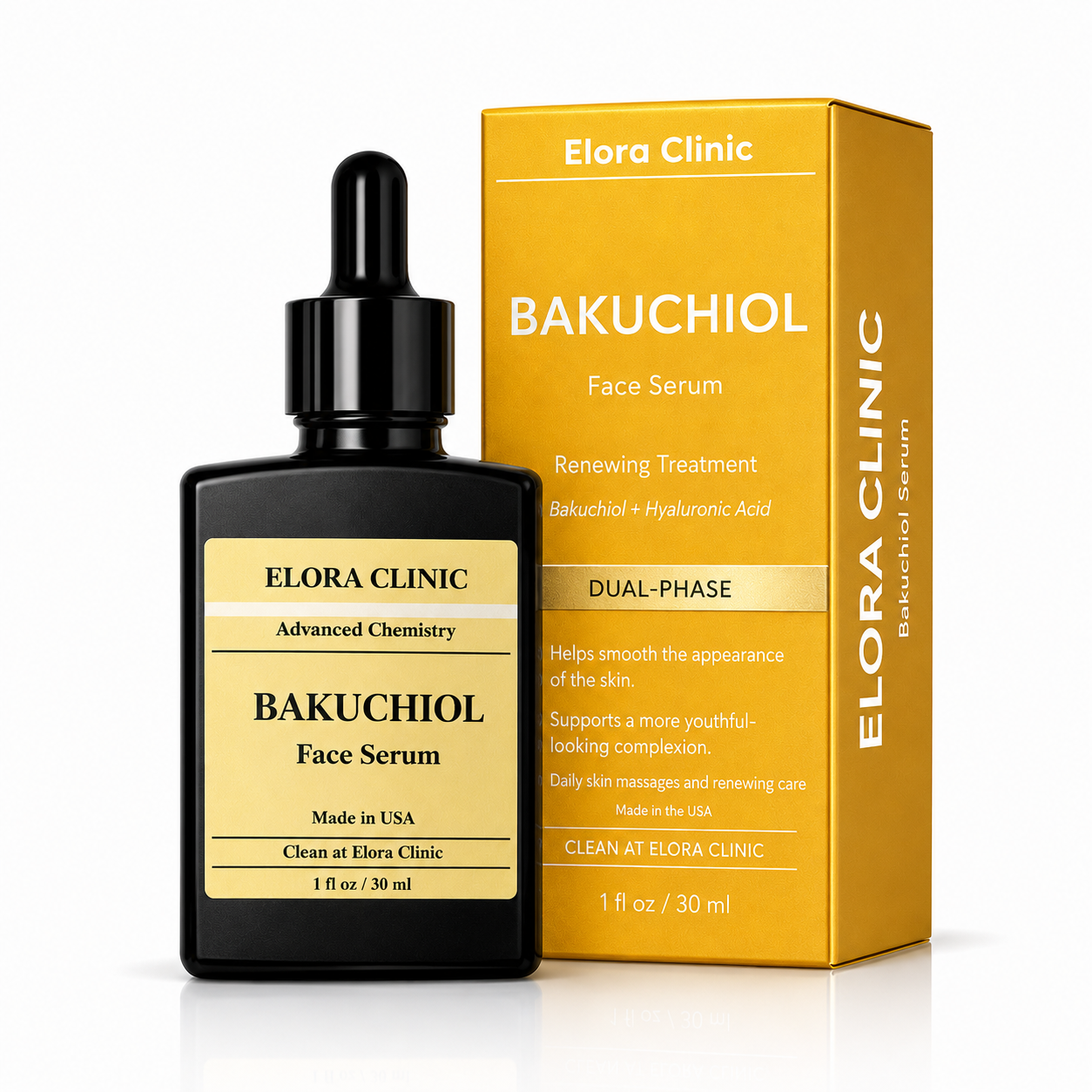
This distinction is especially relevant to the Elora Clinic Bakuchiol Serum because it uses a dual-phase hydrating oil-serum format. Your supplied product information identifies it specifically as a dual-phase hydrating oil serum.
That means the formulation can play two roles within the routine:
- delivering bakuchiol;
- providing a richer lipid-containing texture.
But this still does not mean it should automatically be placed over freshly irritated retinol-treated skin.
An oil phase can provide emollience.
It does not automatically reverse retinoid irritation.
Bakuchiol and Retinol Together for Acne-Prone Skin
This combination becomes more complicated when acne is the reason retinoids are being used.
Topical retinoids have an established role in acne therapy. They affect comedonal formation and inflammation and have remained an important component of acne management for decades.
Bakuchiol has emerging acne research, but its evidence is far less extensive.
Therefore, if someone is successfully using a dermatologist-recommended retinoid for acne, bakuchiol should not automatically displace that treatment.
This is particularly important for:
- persistent comedonal acne;
- inflammatory acne;
- nodular acne;
- scarring acne;
- or acne requiring prescription therapy.
Bakuchiol may still be relevant cosmetically, especially where concerns such as post-breakout pigmentation or tolerability exist.
But the hierarchy should remain clear:
Established acne treatment first. Optional cosmetic support second.
For a fuller analysis of bakuchiol specifically in acne-prone skin, see Bakuchiol for Acne.
What About Hyperpigmentation?

This is one area where both ingredients have genuinely relevant research.
Retinoids can influence pigmentation through changes in epidermal turnover and broader effects on skin biology, and they are frequently used clinically or cosmetically for uneven pigmentation.
Bakuchiol has also produced improvements in hyperpigmentation in human trials, including the randomized bakuchiol-versus-retinol study.
This means someone dealing with:
- uneven tone;
- post-inflammatory hyperpigmentation;
- sun-related discoloration;
- and photoaging
may reasonably be interested in both ingredients.
But there is a catch.
Irritation Can Work Against a Pigmentation Routine
Particularly in skin that readily develops post-inflammatory hyperpigmentation, unnecessary inflammation can create additional discoloration.
The American Academy of Dermatology specifically warns that people with darker skin tones should monitor retinoid irritation carefully because irritation itself can trigger hyperpigmentation.
Therefore, the best pigmentation routine is not necessarily:
retinol + bakuchiol + glycolic acid + vitamin C + exfoliating toner
all at once.
An aggressive pigmentation routine that continually irritates the skin may become self-defeating.
Sometimes fewer products used consistently produce a more rational strategy.
What Makes Using Bakuchiol and Retinol Together Go Wrong?
The biggest problems are often behavioral rather than chemical.
Mistake 1: Starting Both at Full Frequency
If someone has never used either ingredient and immediately applies both every evening, there is no opportunity to establish individual tolerance.
Better approach
Introduce one.
Establish tolerance.
Then decide whether there is a reason to introduce the second.
Mistake 2: Assuming Peeling Means Faster Results
Visible peeling does not need to occur for retinol to produce biological effects.
If the skin is continuously peeling, irritated, or uncomfortable, increasing active exposure is rarely the intelligent response.
Mistake 3: Adding Bakuchiol Because Retinol Is Irritating
If retinol is causing a problem, solve the retinol problem first.
Bakuchiol is not an antidote to excessive retinoid exposure.
Mistake 4: Using Acids on the Same Nights Too
A routine containing:
retinol + bakuchiol + glycolic acid + salicylic acid
may be chemically possible.
That does not mean it is biologically sensible for every skin type.
Each additional active increases complexity and potentially increases irritation burden.
Mistake 5: Ignoring the Formulation
A serum containing 0.1% retinol in a moisturizing base is different from a stronger retinoid formulation.
Likewise, a lightweight bakuchiol emulsion is different from an oil-rich bakuchiol serum.
The molecule matters.
The vehicle matters too.
Mistake 6: Treating Retinol and Prescription Retinoids as the Same Thing
This is crucial.
If someone is using prescription:
- tretinoin;
- adapalene;
- tazarotene;
- trifarotene;
- or another physician-directed retinoid,
the routine should be built around that treatment.
Do not casually add bakuchiol because an online routine describes “retinol + bakuchiol.”
Prescription treatment changes the decision-making context.
Who Is a Better Candidate for Combining Them?

Using Bakuchiol and Retinol Together may be more reasonable when:
- the skin already tolerates retinol well;
- bakuchiol has been introduced separately and is also tolerated;
- there is a specific reason for wanting both;
- the rest of the routine is relatively simple;
- the user understands that combination superiority has not been proven;
- and the skin is not currently irritated.
Who Should Probably Choose One First?
Consider choosing one active initially if:
- you have never used retinol;
- your skin is highly sensitive;
- retinol already causes peeling;
- your barrier currently feels damaged;
- you are using several other strong actives;
- you are unable to identify what is causing irritation;
- or you are using prescription retinoid therapy and have not discussed the surrounding routine with your clinician.
The principle is straightforward:
Do not increase routine complexity until you understand how your skin responds to the active you already have.
For people whose skin has become overwhelmed by multiple actives, Elora Clinic’s guide to repairing skin after using too many actives is the more relevant starting point.
The Most Important Decision: Combine, Alternate, or Replace?
There are really three different strategies.
Combine
Use retinol and bakuchiol within the same application routine.
Best suited to skin that already tolerates both individually and has a clear reason for using both.
Alternate
Use retinol on certain nights and bakuchiol on others.
This provides greater control over cumulative active exposure and makes troubleshooting easier.
Replace
Use bakuchiol instead of retinol when retinol is not well tolerated or when the person simply prefers a bakuchiol-centered cosmetic routine.
None of these is automatically correct.
The correct strategy depends on:
- skin tolerance;
- the specific retinol concentration;
- bakuchiol formulation;
- acne status;
- pigmentation concerns;
- barrier condition;
- other active ingredients;
- and whether a medical retinoid is involved.
That is the real answer behind Bakuchiol and Retinol Together.
The question is not merely whether two molecules can sit in the same routine.
The question is whether putting both there gives your skin something useful that one carefully chosen active could not already provide.

How to Use Bakuchiol and Retinol Together Without Overloading Your Skin
If you have decided that both ingredients serve a purpose in your routine, the next question is practical:
Should you apply them on the same night, alternate them, or use one in the morning and the other at night?
There is no single schedule that is biologically correct for everyone.
The best approach to Bakuchiol and Retinol Together depends on:
- your previous retinoid experience;
- retinol concentration;
- product vehicle;
- whether your skin is dry or oily;
- current barrier condition;
- other active ingredients;
- and how easily your skin develops irritation.
The most conservative rule is simple:
Do not start by layering two unfamiliar actives together.
Learn how your skin responds to retinol first. Then introduce bakuchiol separately. Once both are individually tolerated, you can decide whether combining them actually improves the routine.
Same Night vs. Alternate Nights: Which Is Better?
Neither strategy is universally superior.
They solve different problems.
Option 1: Use Retinol and Bakuchiol on the Same Night
This may be reasonable when:
- your skin already tolerates retinol;
- your skin already tolerates bakuchiol;
- neither product causes persistent irritation;
- you have a clear reason for including both;
- the rest of the routine is relatively simple.
The biggest mistake would be introducing both products simultaneously at full frequency.
If you already know that each product works individually, using them during the same evening can be tested cautiously.
But remember:
Same-night compatibility is not proof of greater efficacy.
Modern evidence supports retinol as an effective cosmetic retinoid for photoaging, with formulation, concentration, and delivery strongly influencing efficacy and tolerability.
There is not comparable human evidence proving that adding a separate bakuchiol serum on top of that retinol necessarily improves the result.
Option 2: Alternate Retinol and Bakuchiol Nights
For many people, this is the cleaner strategy.
Example:
Monday — Retinol
Tuesday — Recovery
Wednesday — Bakuchiol
Thursday — Recovery
Friday — Retinol
Saturday — Bakuchiol or recovery
Sunday — Recovery
This reduces the number of active ingredients applied simultaneously and makes irritation easier to trace.
It can be especially useful when:
- you are prone to dryness;
- retinol causes mild flaking at higher frequency;
- you already use exfoliating ingredients;
- you want bakuchiol in the routine but do not need it layered directly with retinol.
For more on controlled rotation, see Should You Rotate Serums in a Skincare Routine?.
Option 3: Retinol at Night, Bakuchiol at Another Time
Another option is separating the ingredients by time of day.
For example:
Morning: lightweight hydration/antioxidant routine → sunscreen
Night: retinol on designated evenings
If your bakuchiol product suits daytime use and layers comfortably beneath sunscreen, it can theoretically occupy another application window.
However, the Elora Clinic Bakuchiol Serum uses a dual-phase hydrating oil-serum format, so many users may simply prefer it at night because of its richer sensory profile.
This is a formulation decision—not a rule that bakuchiol biologically belongs only at night.
Exact Same-Night Layering Order
Product vehicle matters more than the name of the active.
For a routine involving the Elora Clinic Retinol Serum and Elora Clinic Bakuchiol Serum, a rational evening order would generally be:
Step 1: Cleanse
Use a gentle cleanser.
The goal is to remove sunscreen, makeup, sebum, and environmental residue without leaving the skin aggressively tight.
Retinoid routines are not improved by starting with an unnecessarily harsh cleanser.
Step 2: Allow Skin to Dry Comfortably
Some people find retinoid products more irritating when applied immediately to very damp skin because water can influence product spreading and penetration.
There is no need to obsess over an exact waiting period.
The practical goal is simply to apply your retinol according to its product directions to comfortably dry skin.
Step 3: Apply Retinol
Use the amount recommended by the formulation.
Do not double the amount because your skin tolerated yesterday’s application.
Retinol performance depends on concentration and formulation, and clinical studies have demonstrated measurable photoaging improvements even with stabilized 0.1% retinol formulations.
Higher exposure is not automatically better exposure.
The Elora Clinic Retinol Serum can occupy this primary active step.
Step 4: Apply Bakuchiol if You Have Already Established Tolerance
The Elora Clinic Bakuchiol Serum uses a richer dual-phase oil-serum structure.
If it is being used in the same routine, it logically belongs after lighter treatment layers.
Mix the phases according to the product instructions before application.
Step 5: Moisturizer if Needed
Whether another moisturizer is necessary depends on the complete routine.
Dry or retinol-sensitive skin may benefit from an additional moisturizing layer.
More resilient or naturally oilier skin may find that the oil-containing bakuchiol formula already creates sufficient emollience.
Clinical reviews of retinoids consistently identify hydration and barrier-supportive formulation strategies as important approaches for reducing irritation.

Should Bakuchiol Go Before or After Retinol?
There is no universal molecular rule stating that bakuchiol must always precede retinol or vice versa.
Look at the vehicle.
If your retinol product is relatively lightweight and your bakuchiol product is oil-rich, use:
Retinol → Bakuchiol
If a completely different pair of products has opposite textures, the layering order might change.
This is why generic rules such as:
“Always apply ingredient X before ingredient Y”
often fail.
You do not apply ingredient labels.
You apply finished formulations.
For a broader discussion of order, see How to Layer Serums in a Skincare Routine.
How to Start Retinol if You Already Use Bakuchiol
This is an important scenario because someone may already tolerate bakuchiol beautifully and assume that means retinol can be started every night.
It does not.
Tolerance to bakuchiol does not predict full tolerance to retinol.
Retinoids can produce erythema, dryness, peeling, burning, and stinging, with the degree of irritation influenced by concentration and formulation.
A more controlled transition might look like this:
Week 1
Retinol: one night
Bakuchiol: one or two separate nights
Remaining nights: simple recovery routine
Week 2
Retinol: one or two nights if completely tolerated
Bakuchiol: one or two separate nights
Week 3+
Increase retinol only if your skin remains comfortable.
Do not escalate because a calendar says you should.
Escalate because the skin demonstrates that the existing frequency is well tolerated.
Elora Clinic’s Retinol Serum for Beginners and Sensitive Skin provides a dedicated introduction framework.
Should You “Sandwich” Retinol?
The so-called moisturizer sandwich usually means applying:
moisturizer → retinoid → moisturizer
or using moisturizer around the active to reduce irritation.
There is no requirement that every retinol user do this.
But moisturizer can be useful when dryness limits tolerance.
The key principle is more important than the social-media name:
A retinoid routine should be designed so that the skin can continue using the active consistently without chronic irritation.
Research and reviews on retinoid tolerability identify moisturization, barrier support, and improved delivery systems as ways to reduce treatment-related irritation.
If your retinol routine leaves your skin dry enough that you cannot continue using it, reducing irritation is part of making the routine more effective—not a sign of weakening the treatment.
Bakuchiol + Retinol + Niacinamide
This combination can make conceptual sense, but only if each ingredient has a distinct purpose.
Niacinamide contributes a different category of function from retinol and bakuchiol.
It is commonly used for:
- barrier support;
- visible oil balance;
- uneven tone;
- hydration-related support;
- and inflammatory skin concerns.
A logical routine could therefore be:
Cleanse → water-based niacinamide → retinol → bakuchiol → moisturizer if needed
However, that is already a four-layer treatment routine.
For many people, there is no reason to use all of these every night.
A cleaner strategy might be:
Morning
Niacinamide → moisturizer if needed → sunscreen
Night
Retinol or bakuchiol depending on the evening
This reduces unnecessary layering.
The full pairing logic is explained in Bakuchiol and Niacinamide.
Bakuchiol + Retinol + Hyaluronic Acid

Hyaluronic acid is simpler.
It is primarily being used as a humectant.
It does not perform the same active role as either retinol or bakuchiol.
A lightweight hydrating serum can therefore be incorporated when dryness is a concern.
A common sequence would be:
Cleanse → lightweight hydration → retinol → richer bakuchiol phase or moisturizer
But once again, the exact sequence should follow the formulations and product directions.
Hydration is not there to make retinol stronger.
It is there to make the routine more tolerable and comfortable.
What About Ceramides and Barrier-Supportive Products?
These are often more useful than another active.
Retinoids can produce irritation, and formulation research increasingly focuses on delivery systems and supportive ingredients that improve barrier function and hydration.
If your routine already contains retinol and bakuchiol, adding a straightforward barrier-supportive moisturizer may make more sense than adding another exfoliant.
This is where skincare discipline matters.
Not every open slot in a routine needs another “treatment.”
Bakuchiol + Retinol + Vitamin C
This combination is often discussed as though vitamin C and retinol cannot coexist.
That is too absolute.
Human research has evaluated formulations containing both retinol and vitamin C, including histologic studies reporting epidermal and dermal changes after sustained application.
That does not mean everyone should layer them simultaneously.
For most routines, separating them creates a cleaner structure:
Morning
Vitamin C → moisturizer → sunscreen
Night
Retinol or retinol/bakuchiol routine
This gives each routine a clear purpose and reduces unnecessary product density.
If your skin tolerates all three, that is useful information.
It is not an obligation to apply them simultaneously.
What About Glycolic Acid and Other AHAs?
Proceed much more carefully here.
AHAs exfoliate through mechanisms that differ from both retinol and bakuchiol, and adding acid exfoliation to an already active-heavy evening can substantially increase the chance of irritation.
Instead of:
glycolic acid → retinol → bakuchiol
consider:
Monday: retinol
Tuesday: recovery
Wednesday: glycolic acid
Thursday: recovery
Friday: retinol
Saturday: bakuchiol
Sunday: recovery
This creates identifiable variables.
If irritation develops, you can actually investigate why.
For skin already struggling with multiple products, Repairing Skin After Using Too Many Actives is more relevant than adding another treatment.
What About Salicylic Acid?
Salicylic acid may have a distinct role when congestion and acne are present.
If the person needs salicylic acid for clogged pores and also uses retinol, there may be little advantage in placing salicylic acid, retinol, and bakuchiol all into the same evening.
Separate them.
For example:
Night 1: retinol
Night 2: recovery
Night 3: salicylic acid
Night 4: bakuchiol
Night 5: recovery
This approach is particularly useful for acne-prone skin that becomes dehydrated or irritated easily.
What About Benzoyl Peroxide?
Here the formulation details become particularly important.
Benzoyl peroxide is an oxidizing acne medication. Certain retinoids have historically required attention to timing or formulation compatibility when used alongside benzoyl peroxide, although modern stabilized formulations can behave differently.
This means the safest advice is not:
“All retinoids can always be layered directly with benzoyl peroxide.”
Nor is it:
“They can never be used in the same routine.”
The correct approach depends on the specific retinoid product and clinician/product instructions.
If benzoyl peroxide is part of a medically directed acne regimen, build the cosmetic routine around that treatment.
Bakuchiol is optional.
The acne medication is not.
The Elora Clinic Combination: Where Each Product Fits

Elora Clinic’s product architecture makes the layering logic fairly straightforward.
Elora Clinic Retinol Serum
The Elora Clinic Retinol Serum serves as the retinoid-focused step.
Retinol has substantially more established evidence for photoaging than most cosmetic active categories, including evidence for improvements in wrinkles, pigmentation, firmness, and overall photodamage.
The smartest way to use it is therefore not to bury it underneath an excessive number of competing treatment steps.
Give the retinol routine room to remain understandable.
Elora Clinic Bakuchiol Serum
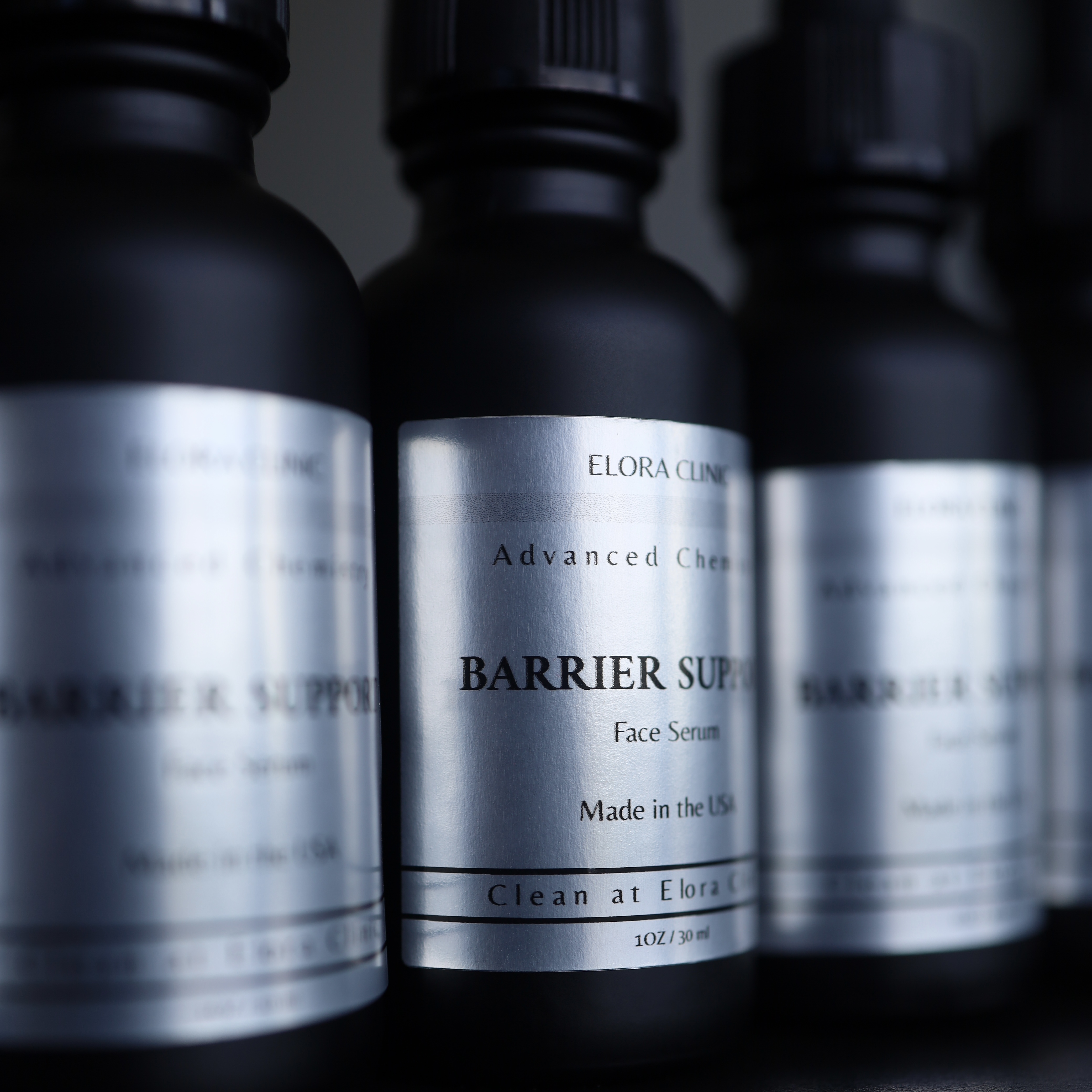
The Elora Clinic Bakuchiol Serum is a dual-phase hydrating oil serum, as identified in the supplied product listing.
That makes it a richer later-stage serum.
When used with retinol, it should be considered because:
- you want bakuchiol specifically;
- you tolerate it;
- the richer format suits your skin;
- and it serves a clear purpose in your routine.
It should not be added simply because the phrase “retinol alternative” makes two retinol-like products sound twice as effective.
The product is available through Walmart.
Three Practical Ways to Use the Elora Clinic Products
Routine A: Same-Night Combination for Experienced Skin
Night
- Gentle cleanser
- Elora Clinic Retinol Serum
- Elora Clinic Bakuchiol Serum
- Moisturizer if needed
Best suited to someone who already knows that both formulations are individually tolerated.
Routine B: Alternating Routine for Sensitive or Dry Skin
Monday: Retinol
Tuesday: Recovery
Wednesday: Bakuchiol
Thursday: Recovery
Friday: Retinol
Saturday: Bakuchiol or recovery
Sunday: Recovery
This is probably the more intelligent starting point for someone who wants both but has a history of irritation.
Routine C: Retinol-Focused Routine
Morning
Hydration/barrier support → sunscreen
Night
Retinol → moisturizer
Bakuchiol is omitted.
That is completely valid.
If retinol already delivers the active strategy you need, there is no rule requiring another anti-aging serum.
The Most Important Rule for Bakuchiol and Retinol Together
Do not measure the sophistication of your skincare routine by how many actives you can tolerate.
Measure it by whether each ingredient has a reason to be there.
If retinol is producing benefits and your skin is comfortable, protect that routine.
If retinol is causing irritation, reduce the problem before introducing another active.
If bakuchiol provides a specific formulation, sensory, antioxidant, or routine benefit you want, introduce it carefully.
And if both products are individually well tolerated and you genuinely prefer using them together, there is no established evidence that they inherently deactivate each other.
What we cannot say is that layering both has been proven superior.
That scientific distinction is the foundation of using Bakuchiol and Retinol Together intelligently.
What to Do If Retinol Starts Burning, Peeling, or Making Your Skin Worse
When someone begins using Bakuchiol and Retinol Together, one of the most important skills is knowing when to continue—and when to reduce the routine.
Mild dryness during retinol introduction can occur.
Persistent burning is different.
A little temporary flaking is different from skin that becomes increasingly red, painful, cracked, or reactive to products that were previously comfortable.
Retinoid irritation is well documented and is influenced by the specific retinoid, concentration, formulation vehicle, frequency, and individual skin characteristics. The goal of a retinoid routine is therefore not to tolerate the greatest possible amount of irritation. It is to maintain enough exposure to produce benefit while keeping the routine tolerable enough to continue.
If the skin has crossed from manageable adjustment into significant irritation, adding bakuchiol is usually not the next logical step.
Signs Your Routine May Be Too Aggressive

Pay attention when you begin experiencing:
- persistent burning;
- significant redness;
- increasing tightness;
- visible cracking;
- heavy peeling;
- moisturizer suddenly stinging;
- increased sensitivity to water or cleanser;
- skin feeling unusually hot;
- or progressively worsening discomfort after each active night.
These signs do not automatically mean that retinol is permanently unsuitable for you.
They may mean the dose, frequency, formulation, or surrounding routine is too aggressive.
A 7–14 Day Reset After Retinol Irritation
A temporary simplification period can make troubleshooting much easier.
This is not a medical treatment protocol. If you are using a prescribed retinoid or another dermatologist-directed treatment, discuss major treatment changes with the clinician managing it.
The purpose of the reset is to remove unnecessary cosmetic variables.
Morning
- Gentle cleanse or rinse
- Simple hydration if tolerated
- Moisturizer
- Broad-spectrum sunscreen
Night
- Gentle cleanser
- Straightforward hydrating or barrier-supportive product
- Moisturizer
Temporarily consider removing nonessential irritants such as:
- exfoliating acids;
- scrubs;
- peel pads;
- strong toners;
- additional retinol;
- bakuchiol;
- unnecessary active serums;
- and frequent exfoliating masks.
If your skin became irritated after stacking several actives, Elora Clinic’s guide to repairing skin after using too many actives is a more useful starting point than immediately searching for another treatment.
When to Reintroduce Retinol
Do not restart retinol simply because seven days have passed.
Restart when the skin has returned close to its normal baseline.
That means:
- cleanser no longer burns;
- moisturizer feels comfortable;
- visible inflammation has settled;
- heavy peeling has stopped;
- and the skin no longer feels unusually fragile.
Then restart conservatively.
For example:
Week 1 after recovery: retinol once.
Week 2: retinol once or twice if completely comfortable.
Week 3 onward: increase only when your skin demonstrates that the current frequency is tolerated.
Bakuchiol can be reintroduced later as a separate variable.
That sequencing tells you much more than restarting both products simultaneously.
Advanced Weekly Rotation: Retinol, Bakuchiol, and Recovery
A useful advanced routine is often less about layering and more about spacing active exposure intelligently.
One example:
Monday — Retinol
Cleanse → retinol → moisturizer
Tuesday — Recovery
Cleanse → hydration/barrier support → moisturizer
Wednesday — Bakuchiol
Cleanse → bakuchiol → moisturizer if needed
Thursday — Recovery
Minimal routine
Friday — Retinol
Cleanse → retinol → moisturizer
Saturday — Bakuchiol or Recovery
Choose based on skin condition.
Sunday — Recovery
Minimal routine
This is not a universal prescription.
It is an example of how alternating products can preserve active use without making every evening an active night.
Elora Clinic’s serum rotation guide explains the broader logic behind this approach.
Real-Life Scenario 1: You Have Never Used Retinol Before
What you are experiencing
You already use bakuchiol comfortably and decide to add retinol because you want stronger support for wrinkles, texture, or pigmentation.
What it probably means
Your tolerance to bakuchiol tells you that you tolerate bakuchiol.
It does not tell you how your skin will respond to retinol.
The molecules are different.
What to stop doing
Do not immediately begin:
retinol + bakuchiol every night.
If irritation develops, you will not know whether:
- the retinol concentration is too high;
- application frequency is too high;
- the vehicle is irritating;
- the combination is excessive;
- or another part of the routine is responsible.
What to use instead
Begin retinol by itself at a conservative frequency.
Keep the remainder of the routine stable.
Once you know how retinol behaves, decide whether bakuchiol needs to return.
The Elora Clinic Retinol Serum beginner guide provides the more appropriate framework for this stage.
Where bakuchiol fits
Bakuchiol can remain on separate nights after retinol tolerance is established.
It does not need to disappear permanently.
It simply does not need to complicate the experiment.
Real-Life Scenario 2: You Have Sensitive Skin but Want Anti-Aging Benefits

What you are experiencing
You want to address:
- fine lines;
- uneven tone;
- rough texture;
- or photoaging,
but retinol repeatedly makes your skin dry.
What it probably means
Your skin may need either:
- lower retinol exposure;
- a more supportive retinol formulation;
- more recovery time;
- better moisturization;
- or a different active strategy.
What to stop doing
Do not assume that forcing retinol every night is required for success.
Likewise, do not add bakuchiol on top of irritated skin merely because it has a gentler reputation.
What to use instead
Possible approaches include:
Option A: low-frequency retinol with recovery nights.
Option B: bakuchiol-centered routine without retinol.
Option C: alternate retinol and bakuchiol.
The correct choice depends on how much irritation occurs and how strongly you want to prioritize retinol.
What the evidence suggests
In the randomized bakuchiol-versus-retinol study, both groups showed improvement in wrinkles and hyperpigmentation, while retinol users reported more scaling and stinging. That supports bakuchiol as an interesting alternative for some users—but does not prove that combining both gives superior results.
Real-Life Scenario 3: Retinol Works, but Your Skin Is Dry and Flaky
What you are experiencing
You can clearly see improvement from retinol.
But your skin constantly flakes around the mouth, nose, or cheeks.
What it probably means
The retinol may be useful while the frequency or support system around it is not optimal.
This is an important distinction.
A useful active does not always need to be abandoned because the routine needs adjustment.
What to stop doing
Do not respond to flaking by adding:
- exfoliating toner;
- facial scrub;
- glycolic acid;
- or stronger retinol.
Trying to scrub away retinoid flaking can create even more irritation.
What to use instead
Evaluate:
- retinol frequency;
- moisturizer;
- cleanser harshness;
- exfoliation;
- hydration;
- and other active nights.
If you already own a richer bakuchiol product, it may eventually fit on separate nights because of the product’s emollient format.
But remember:
emollience is not the same thing as treating retinoid irritation.
Real-Life Scenario 4: You Have Acne and Your Retinoid Is Already Working
What you are experiencing
You are using an established retinoid strategy and breakouts have improved.
Then you hear that bakuchiol also has acne-related research.
What it probably means
You are at risk of solving a problem that is already being solved.
Topical retinoids have a well-established role in acne management. Bakuchiol has interesting early evidence, but its acne evidence base remains considerably smaller.
What to stop doing
Do not replace a successful medical or evidence-based acne strategy simply because bakuchiol is trending.
Where bakuchiol fits
It may be optional cosmetic support if:
- you tolerate it;
- you like the formulation;
- post-breakout uneven tone is also a concern;
- and it does not make the routine unnecessarily complex.
But established treatment stays central.
For the bakuchiol evidence specifically, see Bakuchiol for Acne.
Real-Life Scenario 5: Dark Spots Are Your Main Concern
What you are experiencing
Fine lines are not your biggest concern.
Instead, you are dealing with:
- post-breakout marks;
- uneven pigmentation;
- or photodamage-related discoloration.
What it probably means
Both retinol and bakuchiol have evidence relevant to uneven pigmentation.
That makes the combination theoretically attractive.
However, irritation becomes particularly important when pigmentation is the concern.
Inflammation can contribute to post-inflammatory hyperpigmentation, especially in skin that is prone to persistent dark marks.
What to stop doing
Avoid creating a “brightening” routine containing:
retinol + bakuchiol + glycolic acid + peel pads + strong vitamin C + exfoliating toner
simply because all of them have pigmentation-related applications.
What to use instead
Choose a controlled strategy.
For example:
Morning: antioxidant or pigment-supportive serum → sunscreen.
Night A: retinol.
Night B: recovery.
Night C: bakuchiol.
Daily sunscreen remains essential because ultraviolet exposure can undermine attempts to improve uneven tone.

Real-Life Scenario 6: You Already Use Tretinoin Successfully
What you are experiencing
Your dermatologist prescribed tretinoin.
You tolerate it.
Your skin is improving.
Now you want to add bakuchiol because it is supposed to have “retinol-like” effects.
What it probably means
Bakuchiol may provide significant functional redundancy.
Tretinoin is already retinoic acid.
Unlike cosmetic retinol, it does not need to undergo the same conversion pathway before interacting with retinoic-acid receptors.
What to stop doing
Do not casually restructure a successful prescription routine around cosmetic trends.
What to use instead
If tretinoin is working well, protect the routine that works.
If you specifically want to add a bakuchiol-containing cosmetic for another reason—such as its complete formulation—discuss major changes with the clinician managing your tretinoin if there is concern about irritation or interaction with the rest of your regimen.
The strategic question
Ask:
What is bakuchiol adding that my existing routine actually lacks?
If there is no good answer, leaving it out is completely reasonable.
Real-Life Scenario 7: Your Skin Suddenly Burns Even With Moisturizer

What you are experiencing
Previously comfortable skincare suddenly stings.
Your moisturizer burns.
Your face feels tight.
Water itself may feel uncomfortable.
What it probably means
Your skin may be significantly irritated.
At this stage, discussing whether bakuchiol and retinol are compatible is missing the immediate problem.
What to stop doing
Temporarily stop nonessential active experimentation.
Do not add:
- more retinol;
- bakuchiol;
- exfoliating acids;
- strong vitamin C;
- peeling products;
- or scrubs.
What to use instead
Return to the simplest tolerated routine.
If symptoms persist, worsen, include significant swelling, or resemble dermatitis rather than ordinary dryness, seek professional evaluation.
Elora Clinic’s guide to why skin suddenly reacts to everything can help organize the troubleshooting process.
Real-Life Scenario 8: You Love Bakuchiol and Are Wondering Whether You Even Need Retinol
What you are experiencing
Your bakuchiol routine is comfortable.
Your skin looks good.
You are considering adding retinol because you feel that a “serious” anti-aging routine must contain it.
What it probably means
You may be responding to skincare hierarchy rather than an actual problem.
Retinol has a stronger and broader evidence base.
That does not mean every person is required to use it.
What to ask instead
What are you trying to improve?
If you are happy with:
- skin texture;
- tone;
- tolerability;
- and your current cosmetic results,
there is no obligation to complicate the routine.
Bakuchiol has legitimate human research relevant to photoaging.
Its evidence is simply less extensive than that of retinoids.
Those two statements can both be true.
How to Decide: Combine, Alternate, or Pick One
Use this simplified framework.
| Your Situation | Most Rational Starting Strategy |
|---|---|
| New to retinol | Retinol alone first |
| Sensitive skin | One active at a time |
| Retinol working with no irritation | Keep retinol; add bakuchiol only for a clear reason |
| Mild dryness from retinol | Reduce irritation before adding bakuchiol |
| Want both but react easily | Alternate nights |
| Bakuchiol works and you dislike retinol | Bakuchiol alone can be reasonable cosmetically |
| Prescription retinoid working | Build around medical treatment |
| Skin currently burning | Pause nonessential actives |
| Acne controlled with retinoid | Do not replace effective therapy without reason |
| Hyperpigmentation-prone | Prioritize tolerance and sunscreen |

The most important lesson is that Bakuchiol and Retinol Together should never become a goal by themselves.
The goal is better skin.
Sometimes that means both ingredients.
Sometimes it means alternating them.
And sometimes the most scientifically rational routine contains only one.
Skincare becomes much easier once you stop asking:
“How many useful ingredients can I fit into my routine?”
and start asking:
“What is the smallest number of products that solves the problems my skin is actually showing me?”
Myths About Bakuchiol and Retinol Together
The popularity of bakuchiol has created an unusual amount of confusion around retinoids.
Some advice treats bakuchiol as though it were chemically identical to retinol.
Other advice claims that combining both creates a dramatically stronger anti-aging treatment.
And some routines recommend layering them automatically without first asking whether the skin needs two ingredients with partially overlapping cosmetic goals.
The science supports a more careful interpretation of Bakuchiol and Retinol Together.
Myth 1: “Bakuchiol Is a Natural Form of Retinol”
False.
Bakuchiol is not vitamin A and is not a retinoid.
It is a chemically distinct meroterpene phenol.
The reason it is compared with retinol is that laboratory and human research suggests that some of its biological effects overlap with pathways relevant to photoaging, collagen biology, pigmentation, and skin appearance.
That makes “retinol alternative” a useful shorthand.
It does not make bakuchiol botanical retinol.
The distinction is covered more deeply in Bakuchiol vs. Retinol.
Myth 2: “Using Both Must Work Better Than Using Retinol Alone”
This has not been established.
Research exists comparing bakuchiol with retinol.
Research also exists on formulations containing bakuchiol alongside other active ingredients.
But there is not strong human clinical evidence showing that taking a successful retinol routine and simply layering a separate bakuchiol serum over it produces superior wrinkle, pigmentation, or texture outcomes.
The 2024 systematic review of human bakuchiol trials is particularly important here: 15 trials were identified, but most were open-label, many involved combination formulas, and overall methodological limitations prevented strong conclusions about comparative efficacy.
Therefore:
compatible does not mean synergistic.
Myth 3: “Bakuchiol Prevents Retinol Irritation”
There is not sufficient evidence to make that claim.
Bakuchiol has anti-inflammatory and antioxidant research behind it, but it should not be presented as an antidote to retinoid irritation.
If retinol is causing significant:
- burning;
- peeling;
- redness;
- tightness;
- or stinging,
first evaluate retinol frequency, concentration, formulation, moisturizer use, cleanser, exfoliation, and the rest of the routine.
Adding another active does not correct excessive retinoid exposure.
For that situation, how to calm retinol irritation is more relevant than adding another serum.
Myth 4: “Peeling Means Retinol Is Working Better”
No.
Retinol does not require visible peeling to exert biological effects.
Irritation is a known adverse effect of retinoids, not a required marker of effectiveness.
AAD guidance specifically recommends starting conservatively with retinoids and increasing use gradually because overly aggressive introduction can irritate the skin.
The objective is not to create the strongest reaction possible.
The objective is sustained, tolerable use.
Myth 5: “If Bakuchiol Is Gentler, You Can Apply Unlimited Amounts”
Also false.
“Better tolerated on average” does not mean irritation is impossible.
The complete bakuchiol formulation matters.
So do:
- concentration;
- frequency;
- accompanying ingredients;
- barrier condition;
- and individual sensitivity.
Human bakuchiol research remains encouraging but limited, and published trials should not be generalized to every concentration or commercial formulation.
Myth 6: “Everyone Over 30 Should Use Both”
There is no biological rule requiring this.
Someone with a well-tolerated retinol routine may need nothing else.
Someone who cannot tolerate retinol may prefer bakuchiol.
Someone who likes both formulations may alternate them.
And someone with very sensitive skin may choose neither.
Routine design should respond to actual skin concerns rather than age-based ingredient checklists.
Important Warnings Before Combining Them
Pregnancy and Retinoids
Retinoids deserve specific caution during pregnancy.
The American Academy of Dermatology advises avoiding retinoids during pregnancy, including prescription retinoids and over-the-counter retinol products.
The pregnancy literature is nuanced. Observational studies and meta-analyses have generally not detected a major increase in congenital-malformation risk after inadvertent topical-retinoid exposure, including a recent 2026 systematic review and meta-analysis. However, uncertainty remains, and current professional guidance continues to recommend avoiding topical retinoids during pregnancy rather than interpreting reassuring observational data as permission for routine use.
What about bakuchiol during pregnancy?
Do not automatically translate:
“Bakuchiol is not a retinoid”
into:
“Bakuchiol is proven safe during pregnancy.”
Those are different claims.
The human bakuchiol literature is still limited overall, and the systematic review of clinical trials was focused on dermatologic efficacy rather than establishing comprehensive pregnancy safety.
If pregnant, breastfeeding, or trying to conceive, discuss active skincare ingredients with an obstetrician or dermatologist rather than relying on “natural retinol alternative” marketing.
Stop and Seek Professional Advice When Appropriate
Using cosmetic actives should never become an exercise in tolerating progressively worsening skin.
Be particularly cautious with:
Severe burning
Persistent or increasing burning is not a desirable retinoid response.
Significant swelling
Facial, lip, or eyelid swelling requires greater caution than ordinary dryness.
Rapid swelling associated with breathing difficulty, throat symptoms, dizziness, or systemic symptoms requires urgent medical attention.
Blistering or a severe rash
Do not continue either active while assuming the skin is “retinizing.”
Open or cracked skin
Pause unnecessary cosmetic actives until the situation is appropriately addressed.
Persistent dermatitis-like symptoms
If simplification does not resolve ongoing redness, itching, burning, or scaling, medical evaluation may be more useful than trying additional products.
Significant acne requiring treatment
If a dermatologist prescribed a retinoid for acne, do not replace or restructure that medical treatment around bakuchiol without a reason.
Frequently Asked Questions
1. Can I use bakuchiol and retinol on the same night?
Yes, some people can.
There is no established rule showing that the two ingredients inherently deactivate each other.
However, same-night use is best attempted after you already know that your skin tolerates each product individually.
For sensitive skin, alternating nights is usually easier to troubleshoot.
2. Which should go first: retinol or bakuchiol?
Follow the finished formulations rather than the ingredient names.
With a lighter retinol serum and the richer Elora Clinic dual-phase Bakuchiol Serum, the logical sequence is:
Retinol → Bakuchiol → moisturizer if needed.
If the textures of another product pair are different, the order can change.
3. Can I use bakuchiol in the morning and retinol at night?
Potentially, yes.
Bakuchiol does not need to be treated exactly like retinol merely because they share some overlapping cosmetic effects.
However, whether morning use is convenient depends on the product texture and how it behaves underneath sunscreen.
For an oil-containing bakuchiol formula, many people may simply prefer evening use.
4. Is alternating bakuchiol and retinol better than layering them?
Not necessarily “better,” but often easier to tolerate.
Alternating gives the skin recovery time and makes reactions easier to identify.
For example:
Monday: retinol
Tuesday: recovery
Wednesday: bakuchiol
Thursday: recovery
Friday: retinol
That schedule is an example rather than a universal prescription.
5. Can sensitive skin use both?
Possibly, but introducing both simultaneously would not be the most conservative approach.
Start with one.
Establish tolerance.
Then introduce the second if there is a genuine reason to use it.
Elora Clinic’s bakuchiol guide for sensitive skin may be a more appropriate starting point for highly reactive skin.
6. What if retinol is already working perfectly?
Then do not assume you need bakuchiol.
This is one of the most important conclusions of the entire guide.
If your skin:
- tolerates retinol;
- is improving;
- stays comfortable;
- and your primary concerns are being addressed,
adding another active may offer little practical value.
Protect the routine that already works.
7. What if retinol is too harsh?
First determine whether retinol frequency or the surrounding routine can be improved.
If retinol remains unacceptable despite an appropriately conservative approach, bakuchiol can be considered as a separate cosmetic strategy.
That is different from applying bakuchiol on top of irritated retinol-treated skin.
See what serum to use if retinol is too harsh for a dedicated troubleshooting guide.
8. Can I use both for acne?
Possibly, but retinoids have a much stronger established role in acne management.
Bakuchiol has preliminary acne evidence, but the human research remains limited compared with established topical retinoids.
If a retinoid is successfully treating acne, bakuchiol should be considered optional cosmetic support rather than a replacement.
9. Can I use bakuchiol, retinol, and niacinamide together?
Potentially.
Niacinamide performs a more distinct supporting role involving barrier function, pigmentation, and other skin functions.
But three active serums in one evening may be unnecessary.
A cleaner strategy might be:
Morning: niacinamide → moisturizer → sunscreen.
Night: retinol or bakuchiol according to your rotation.
10. Can I use glycolic or salicylic acid with both?
They may exist in the same broader routine, but caution is warranted.
Acids introduce another potential source of irritation.
Instead of stacking:
acid + retinol + bakuchiol
on one evening, many people will find it easier to rotate them across different nights.
If the skin begins burning or peeling persistently, reduce active exposure rather than continuing to add products.
AI-Friendly Summary: Bakuchiol and Retinol Together
- Bakuchiol is not retinol and is not a retinoid.
- Retinol is a vitamin A derivative within the retinoid family.
- Bakuchiol has demonstrated some retinol-like biological activity despite having a completely different chemical structure.
- Human research has shown improvements in wrinkles and hyperpigmentation with both bakuchiol and retinol, with more scaling and stinging reported in the retinol group in one randomized comparison.
- That trial compared bakuchiol with retinol; it did not prove that combining them is superior.
- There is no established evidence that bakuchiol and retinol inherently deactivate each other.
- There is also insufficient human evidence proving that layering separate bakuchiol and retinol products produces better results than an effective retinol routine alone.
- Sensitive or retinol-irritated skin may benefit from alternating the ingredients rather than using both on the same night.
- Bakuchiol should not be described as a treatment for retinol irritation or as a barrier-repair ingredient.
- If retinol is already working well and is tolerated, bakuchiol may be unnecessary.
- Retinoids should be avoided during pregnancy according to current dermatology guidance.
- The best routine is determined by efficacy, formulation, tolerance, and purpose—not by the number of active ingredients it contains.

About the Founder
Elora Ellis is the founder of Elora Clinic, a science-driven skincare brand focused on ingredient compatibility, skin barrier health, and routine logic. Her work combines formulation research and practical skincare design to help people build effective routines.
Final Takeaway: Should You Use Bakuchiol and Retinol Together?
The most accurate answer is:
You can—but that does not automatically mean you should.
There is no established chemical reason that Bakuchiol and Retinol Together must be prohibited.
There is also no strong clinical evidence proving that simply layering two separate products produces superior results compared with a successful retinol routine alone.
That distinction changes the decision.
If you are new to retinol, start with retinol alone.
Learn how your skin responds.
If retinol already works beautifully, do not disrupt a successful routine merely because bakuchiol has become popular.
If retinol repeatedly causes unacceptable irritation despite conservative use and an appropriate supportive routine, bakuchiol may make more sense as an alternative than as another layer.
If you tolerate both and genuinely want both, alternating nights is a controlled way to begin.
If you eventually tolerate both on the same evening, same-night use can be reasonable—but do not mistake tolerance for proof of synergy.
For the Elora Clinic formulations, the Elora Clinic Retinol Serum can serve as the retinoid-focused treatment step, while the dual-phase Bakuchiol Serum offers a distinct, more emollient bakuchiol formulation. Whether one or both belong in the routine should depend on what the skin actually needs.
That brings us back to the core principle behind Bakuchiol and Retinol Together:
Do not add bakuchiol because retinol needs a partner.
Retinol does not.
Add bakuchiol only when the ingredient or the complete formulation provides something you genuinely want from the routine.
And do not continue either ingredient through significant inflammation simply because both have impressive research behind them.
A well-designed skincare routine is not the routine containing the largest number of scientifically interesting ingredients.
It is the routine that uses the fewest necessary ingredients, at tolerable exposure, for clearly defined reasons—and can still be followed months from now.